

The Parable of the Lamp on a Stand, is found in Matthew 5:14–15, Mark 4:21–25, and Luke 8:16–18. In this parable, Jesus teaches that a lamp is not meant to be hidden under a bowl or a bed, but rather placed on a stand to give light to everyone in the house. The message is about the visibility and influence of good works and truth. It emphasizes the importance of sharing one’s light (faith, good deeds, truth) with the world, rather than concealing it, and encourages openness and transparency in living out one’s beliefs. The parable also underscores the idea that nothing hidden will remain secret and that truth will always come to light.
In the heart of these teachings lies a simple yet profound truth: the light within us is meant to shine brightly, not to be hidden away. This light is a metaphor for the goodness, truth, and love that resides in each of us, a divine spark that connects us all.
From a perspective of inner exploration and self-awareness, this light represents our truest selves, the part of us that is pure, good, and connected to something greater than ourselves. It’s a reminder that within each of us lies a potential for greatness, for goodness, for making a positive impact in the world. By allowing this light to shine, we not only illuminate our own paths but also help to light the way for others.
This teaching also speaks to the interconnectedness of all life. Just as a single candle can light many others without diminishing its own flame, so too can the goodness in one heart ignite the goodness in many others. This interconnectedness is a fundamental truth of existence, reminding us that we are all part of a greater whole, all connected by the same divine spark.
Moreover, these words encourage us to be mindful of how we perceive and interact with the world. The measure with which we approach life – be it with kindness, generosity, or understanding – is the measure that will come back to us. It’s a call to live consciously, to be aware of our actions and their impacts, and to strive always to act from a place of love and compassion.
Finally, this teaching is an affirmation of the power of truth and integrity. Just as a hidden light serves no purpose, so too does hiding our truth or pretending to be something we’re not serve no one. By being true to ourselves, by living authentically and with integrity, we allow our inner light to shine forth, guiding us and those around us.
In essence, this message is one of hope, love, and transformation. It’s a reminder that each of us has within us a light – a potential for goodness, kindness, and connection – that, when nurtured and allowed to shine, can transform not just our own lives but also the world around us. So let us each strive to be a beacon of light in our own lives, illuminating the path for ourselves and for others, and in doing so, help to create a world filled with light, love, and goodness.

The parable of the new cloth and new wine in old bottles, found in Matthew 9:16-17, Mark 2:21-22, and Luke 5:36-38, carries profound insights that resonate across both spiritual and psychological realms.
At its core, this parable speaks about the incompatibility of new and old ways, beliefs, or structures. From a spiritual standpoint, it emphasizes the transformative nature of spiritual truths and experiences. The “new cloth” and “new wine” can be seen as new understandings, beliefs, or ways of being that Jesus introduced, which couldn’t be integrated into the old, rigid structures of religious law and tradition of the time. It suggests that embracing these new teachings requires a fresh, flexible approach, akin to new wineskins that can expand and grow.
Psychologically, this parable reflects the process of personal growth and transformation. It suggests that when we gain new insights or undergo significant personal growth, our old ways of thinking and being may no longer suffice. Trying to fit these new understandings into our old frameworks (the old garment or wineskins) can lead to conflict and discomfort. It implies the need for a renewal of our inner selves to accommodate and fully integrate new experiences and insights.
This idea also resonates with the concept that within each of us lies a divine spark, a potential for growth and transformation. Embracing this inner divinity means shedding old patterns and limitations and adopting new, more expansive ways of being. It’s about allowing ourselves to grow and evolve, to become new “wineskins” that can hold the “new wine” of our evolving selves.
Moreover, the parable highlights the importance of readiness and openness to change. Just as new wine requires new bottles, our new selves, with new understandings and insights, require a new mindset and approach to life. It’s a call to be open to transformation, to be willing to let go of the old to make room for the new.
In summary, the parable of the new cloth and new wine in old bottles teaches us about the necessity of renewal and flexibility in the face of new truths and personal growth. It underscores the importance of letting go of outdated beliefs and ways of being to fully embrace and integrate new insights and experiences. This message aligns with the transformative journey of love, hope, and continuous personal growth, echoing the belief that each of us is capable of profound change and spiritual evolution.

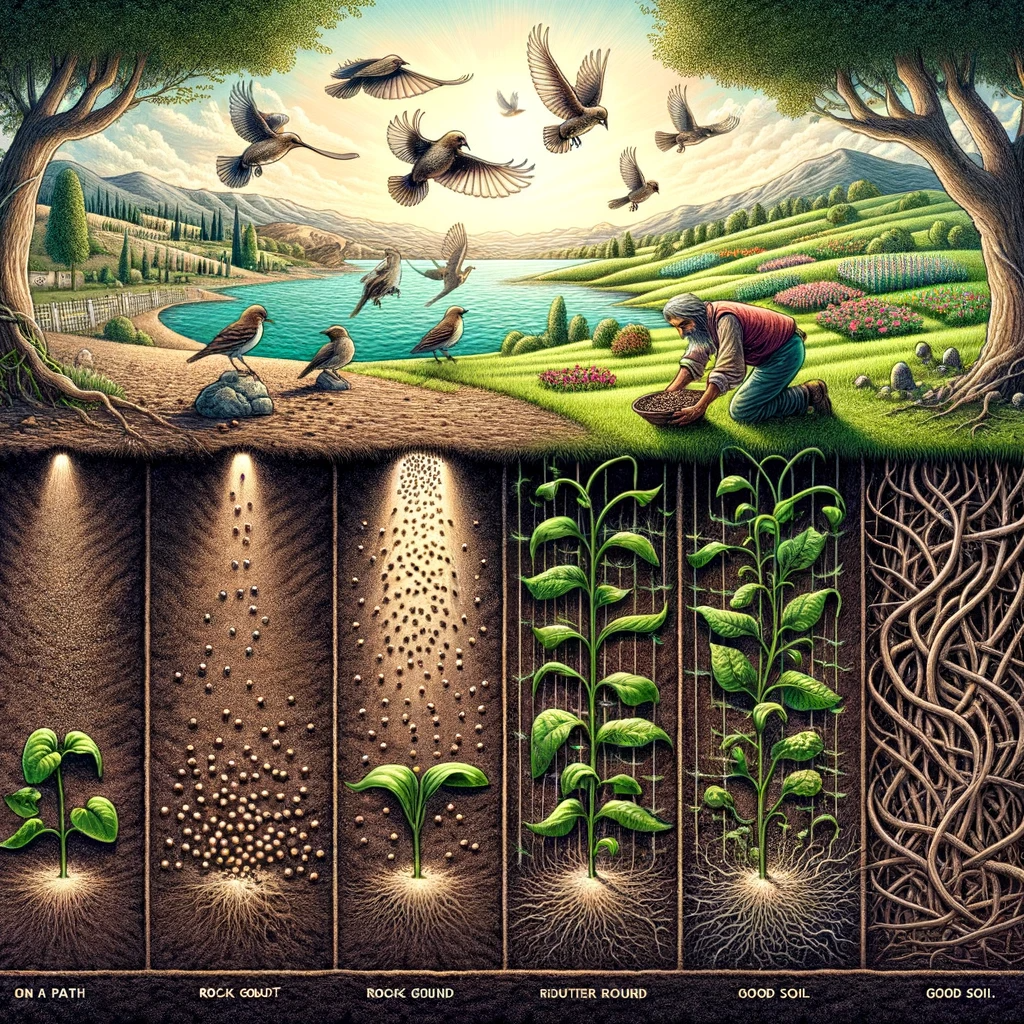
In the parable of the Sower, Matthew 13:1-23, Mark 4:1-20, and Luke 8:4-15, Jesus compares the word of God to seed that falls on different types of soil, representing how people receive the word. Those who accept the word wholeheartedly bear abundant fruit.
This profound narrative, known as the Parable of the Sower, carries profound layers of wisdom and spiritual lessons that can guide us to a deeper understanding of our lives, our connection to God, and our inner selves.
In simple terms, the story is about a sower who scatters seeds on different types of ground – some fall on the path, some on rocky soil, some among thorns, and some on good soil. The seeds represent the divine message or truth that God plants in our hearts, which is the core of who we are. The different types of soil symbolize the various conditions of our hearts and minds and how we receive and nurture this divine message.
The seeds that fall on the path and are eaten by birds symbolize those moments when we hear the divine message but do not comprehend it. It’s like when we hear a profound truth, but our minds are so preoccupied with our daily concerns that we don’t even acknowledge it, and so the truth is lost.
The seeds that fall on rocky soil represent those of us who receive the divine message with joy, but we don’t allow it to penetrate deeply into our lives. We may feel inspired for a moment, but when difficulties come, our faith wavers and the message withers, like a plant without deep roots.
The seeds that fall among thorns symbolize the divine message being choked by worldly worries and desires. This is when we hear the divine message, but our minds are so filled with concerns about money, status, or pleasure that we don’t make space for the message to grow and flourish.
The seeds that fall on good soil represent those of us who not only hear the divine message but understand and live it. We let it penetrate deeply into our hearts, and it transforms us. We bear the fruits of love, peace, joy, and other qualities that reflect the divine nature within us.
This story teaches us that the divine message or truth is available to everyone. It’s like a broadcast signal that’s always on. However, whether we receive and bear fruit from this message depends on the condition of our hearts and minds. If our minds are preoccupied with worldly concerns or if we lack a deep commitment, we may not fully receive or live the divine message. But if our hearts are open, receptive, and committed, we can bear abundant fruit.
The challenge, then, is to cultivate our “inner soil” so that it becomes good ground for the divine message. This involves quieting our minds, opening our hearts, and deepening our commitment to live according to the divine message. It involves recognizing that God’s love is within us and everyone else, and that we are interconnected. As we do this, we can experience a profound transformation, like a seed that grows into a fruitful plant.
In essence, the Parable of the Sower invites us to reflect on how we are receiving and living the divine message in our lives. It’s a call to cultivate our inner soil so that we can bear the fruits of divine love, peace, joy, and other qualities that reflect the God within us. It’s a call to recognize that God’s love is within us and everyone else, and that we are interconnected. As we do this, we can experience a profound transformation, like a seed that grows into a fruitful plant. This is the good news of the gospel: that we are all loved by God and have the potential to live a meaningful and fulfilling life.
In these verses, Jesus teaches a large crowd that has gathered around Him by the sea. He tells the Parable of the Sower, a story about a farmer who sows seeds on different types of ground. Some seeds fall on a path and get eaten by birds. Other seeds fall on rocky ground and, while they quickly sprout, they soon wither because they have no depth of soil. Some seeds fall among thorns, which grow up and choke them. But some seeds fall on good soil and yield a fruitful crop.
When His disciples ask Him about the meaning of the parable, Jesus explains that the seeds represent the word of God. The different types of ground represent the various responses people have to God’s word. Some people, like the path, do not understand the word, and so the evil one comes and snatches away what has been sown in their heart. Others, like the rocky ground, initially receive the word with joy but quickly fall away when troubles arise because they lack a firm root. Still, others, like the ground with thorns, hear the word but the worries of life and the deceitfulness of wealth choke it, making it unfruitful. But those who are like the good soil hear the word, understand it, and produce a fruitful yield.
Jesus emphasizes that the disciples are blessed because they are able to understand these spiritual truths, unlike the rest of the crowd. He states that many prophets and righteous people longed to see and hear such things but did not. The chapter concludes with Jesus encouraging those who have “ears to hear” to truly listen and comprehend His teachings.
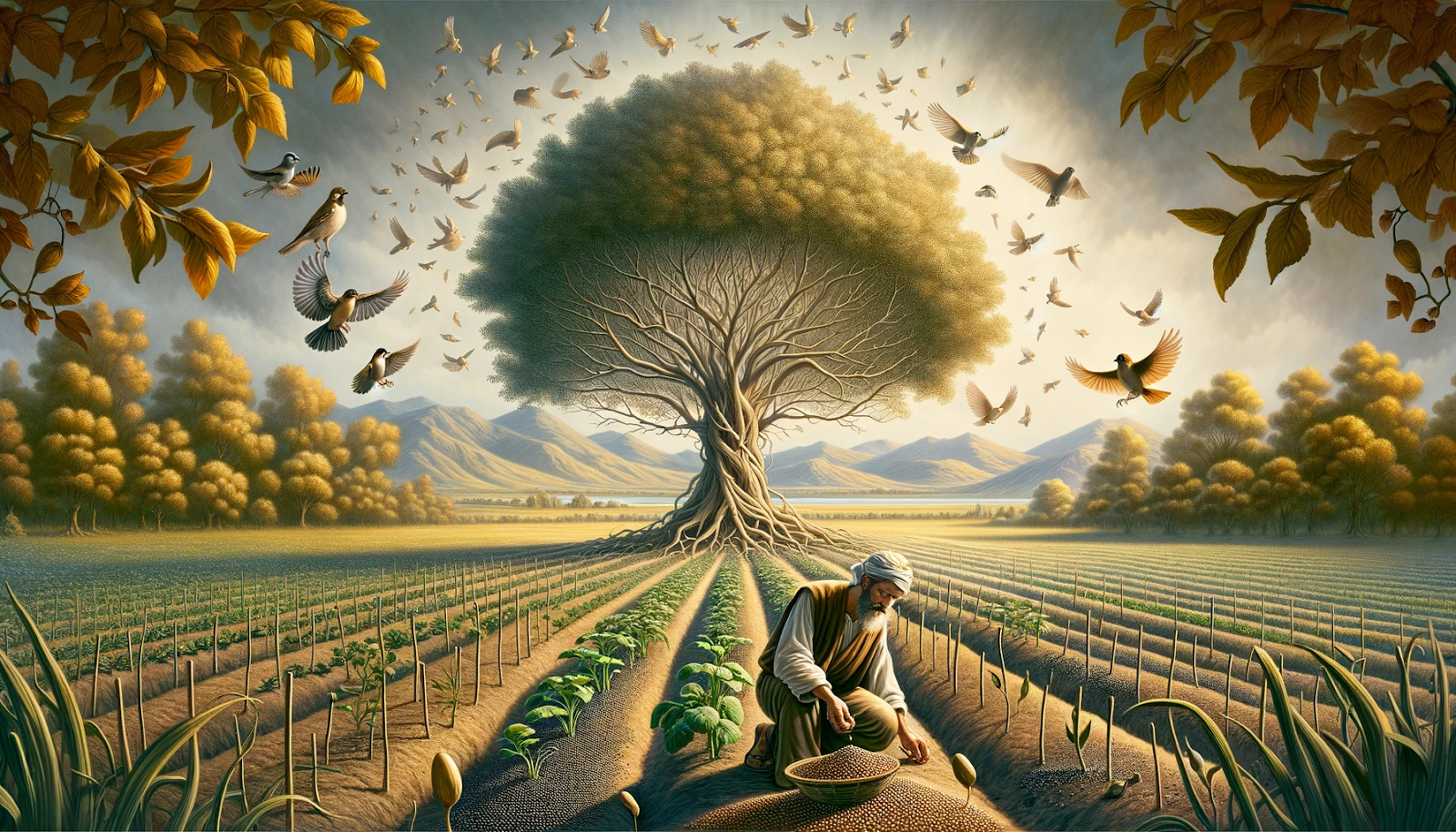
The Parable of the Mustard Seed appears in Matthew 13:31-32, Mark 4:30-32, and Luke 13:18-19. In this parable, Jesus likens the Kingdom of Heaven to a mustard seed, one of the smallest seeds that grows into a large tree, offering shelter to birds. This story illustrates the idea of significant growth from small beginnings and symbolizes the expansive and inclusive nature of the Kingdom of Heaven.
In this simple parable of the mustard seed, a deep and multifaceted truth is woven, touching upon spirituality, personal growth, and the interconnectedness of all life.
From a spiritual perspective, this parable teaches us about the nature of faith and the Kingdom of Heaven. Just as a tiny mustard seed grows into a large tree, so too can a small amount of faith or understanding grow into something profound and life-encompassing. It tells us that the beginnings of spiritual growth may seem small and insignificant, but with care and nurturing, they can grow into something vast and nurturing in their own right.
Looking at this parable through a lens of personal growth and inner exploration, the mustard seed represents our potential. Each of us carries within us a seed – a potential for growth, understanding, and transformation. This potential, when nurtured by experiences, learning, and introspection, can grow into a strong, deeply rooted understanding of ourselves and our place in the world. Just as the mustard tree provides shelter for birds, our personal growth offers shelter and support to those aspects of ourselves that need it – our hopes, our dreams, our vulnerabilities.
This story also speaks to the interconnectedness of life. The tree does not grow in isolation; it becomes a home and a haven for the birds. Similarly, our growth and actions are interconnected with the world around us. Our personal development has the power to affect not just ourselves, but also those we come into contact with, creating a ripple effect of growth, understanding, and compassion.
There’s also a message of hope and encouragement in this parable. It tells us that no matter how small or insignificant our beginnings might seem, there’s always the potential for something greater. It encourages us to start where we are, use what we have, and do what we can, in the faith that it can lead to something greater than we might have imagined.
In essence, the Parable of the Mustard Seed is a story of beginnings, growth, and potential. It teaches us that within each of us is a seed of potential that, when nurtured, can grow into something grand and beautiful. It reminds us of our interconnectedness with the world around us and encourages us to live our lives in a way that nurtures and supports not just ourselves, but also those around us. It is a story of hope, growth, and the transformative power of faith and understanding.
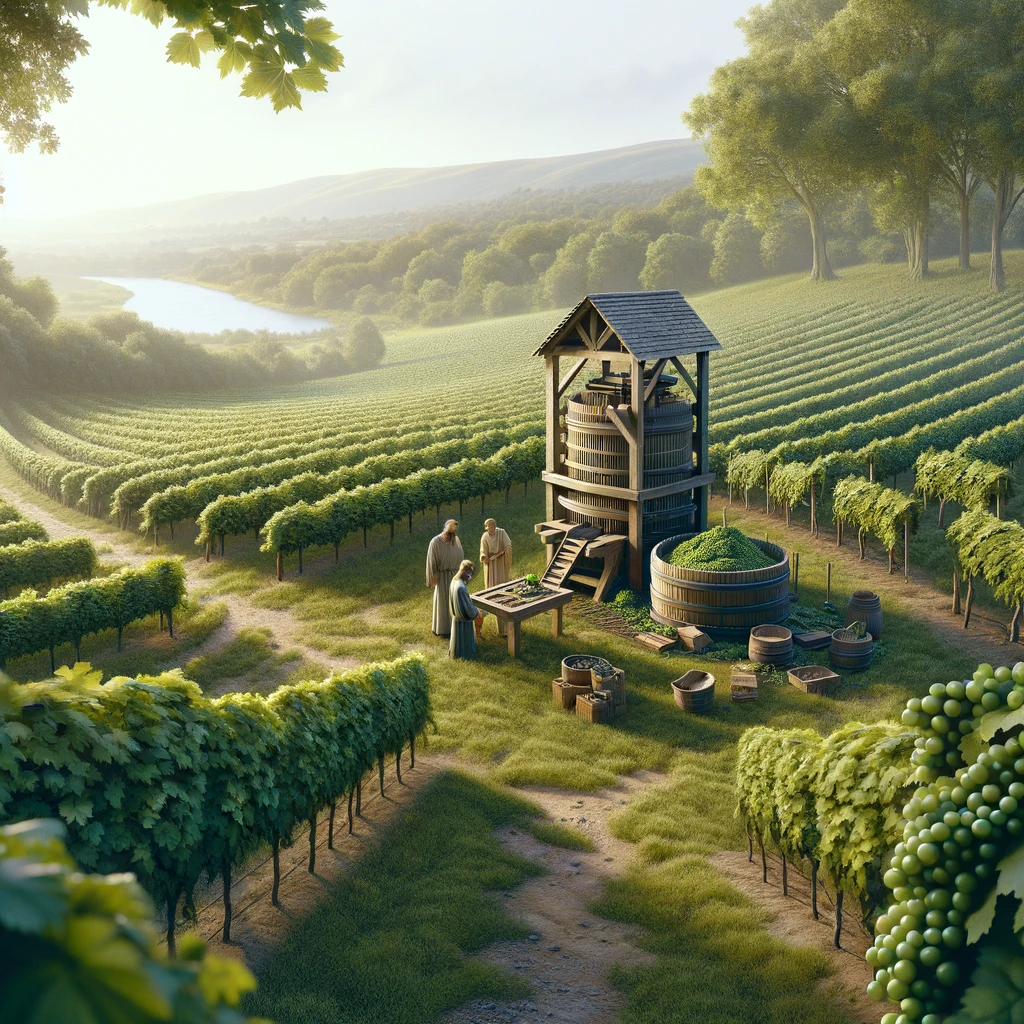
In the parable of the wicked tenants, found in Matthew 21:33-46, Mark 12:1-12, and Luke 20:9-19, a landowner plants a vineyard, encloses it with a hedge, builds a winepress and a tower, and leases it out to tenants. When the time comes to collect the fruits of the vineyard, the landowner sends servants to the tenants, but they beat one, kill another, and stone another. The landowner sends more servants, but they receive the same treatment. Finally, the landowner sends his beloved son, hoping that the tenants will respect him. However, the tenants conspire to seize the inheritance and kill the son.
This parable, known as the Parable of the Tenants or the Wicked Husbandmen, is a profound tale about the relationship between God, humanity, and the world. It speaks to us on many levels, offering insights that can transform our understanding of life and our place in it.
From a Christian perspective, the householder represents God, and the vineyard is the world, which God has lovingly and carefully created. The husbandmen, or tenants, symbolize us – humanity, who have been entrusted with the care of the world.
The servants sent by the householder are the prophets, messengers of God’s word, who were often mistreated and rejected by the people to whom they were sent. The son, of course, signifies Jesus, who was also rejected and killed.
The core message here is that God has given us a world to care for and has sent us guidance through prophets and through His son, Jesus. And yet, we often reject that guidance, choosing instead to live by our own rules and desires. The parable warns of the consequences of such rejection, but also offers hope that even in the face of our failures, God’s plan – represented by the stone that the builders rejected becoming the cornerstone – will still come to pass.
Now, take a moment to consider this story from a different angle, one that looks within us. Imagine the vineyard as your own life, the fertile ground of your soul. The husbandmen are your thoughts, emotions, and actions. The servants and the son sent by the householder are the inner promptings of love, truth, and wisdom.
Too often, we reject these promptings, choosing instead to follow our selfish desires and fears. We may even “kill” the son, silencing our inner voice of love and truth. But the parable assures us that these promptings are resilient. Even when rejected, they can become the cornerstone of our life.
In essence, the parable is an invitation to cultivate our inner vineyard with care and love, to listen to the voice of truth within us and to live in harmony with the world around us. This is the path to a meaningful and fulfilling life.
Remember, God is within us, in the love, truth, and wisdom that guide us. And God is also in others, connecting us all in a network of divine love. When we recognize and embrace this divine presence within and around us, we can transform our lives and our world.
So, as you navigate your journey, heed the lessons of this parable. Cultivate your vineyard, listen to your inner promptings, and know that you are deeply loved and connected to all. This is the good news of the gospel, a message of love, hope, and transformation.
In the parable of the fig tree, found in Matthew 24:32-36, Mark 13:28-32, and Luke 21:29-33, Jesus compares the observing of the signs of the times to the budding of a fig tree, indicating that summer is near. Just as the budding of a fig tree signals the imminent arrival of summer, Jesus teaches that the signs of the times will precede the nearness of the kingdom of God. However, the exact day and hour of the kingdom’s arrival remain unknown, a secret held only by God the Father.
This parable, often referred to as the Parable of the Fig Tree, brings forward a profound message about understanding the signs of the times and the enduring nature of truth.
Let’s consider this from a Christian perspective first. The fig tree is a symbol of Israel in scripture, and its branch becoming tender and putting forth leaves is a sign of the coming of summer. This is an illustration of how we can read the signs of the times – when we see events unfolding as foretold in God’s word, we can know that His promises are nearing fulfillment.
The statement, “This generation shall not pass, till all these things be fulfilled,” underscores the immediacy of God’s kingdom. It also emphasizes the enduring nature of God’s word: “Heaven and earth shall pass away, but my words shall not pass away.” Despite the changes in the world, God’s truth remains constant and unchanging.
Now, let’s delve deeper into the inner world of the self. Imagine the fig tree as a symbol of your own life. The budding of the fig tree can be seen as an awakening – the blossoming of understanding and awareness in your life. It’s a sign that a change, like the arrival of summer, is coming.
When you observe changes in your own feelings, thoughts, and actions, you can understand that a transformation is near. Just as the budding fig tree signifies the arrival of summer, these inner changes signpost your growth and evolution.
The assertion that “heaven and earth shall pass away, but my words shall not pass away” can be viewed as an affirmation of the enduring power of truth and love within you. Despite the changes in your life and the world around you, the truth of love and your inherent worth as a loved child of God remain unchanging.
The parable concludes with the mystery of the unknown: “But of that day and hour knoweth no man, no, not the angels of heaven, but my Father only.” This reminds us that while we can read the signs of our inner and outer lives, the exact timing and nature of our transformations are beyond our control.
In essence, the Parable of the Fig Tree is an invitation to remain alert to the signs of change within and around us, to trust in the enduring nature of truth and love, and to embrace the mystery of life with faith.
And so, as you journey through life, remember that you carry within you a divine spark of love and truth. Watch for the signs of its budding and know that you are cherished and connected to all, part of a grand, unfolding divine plan. This is the good news of the gospel, a message of love, hope, and transformation.
 Modern Mosaic
Leave a comment