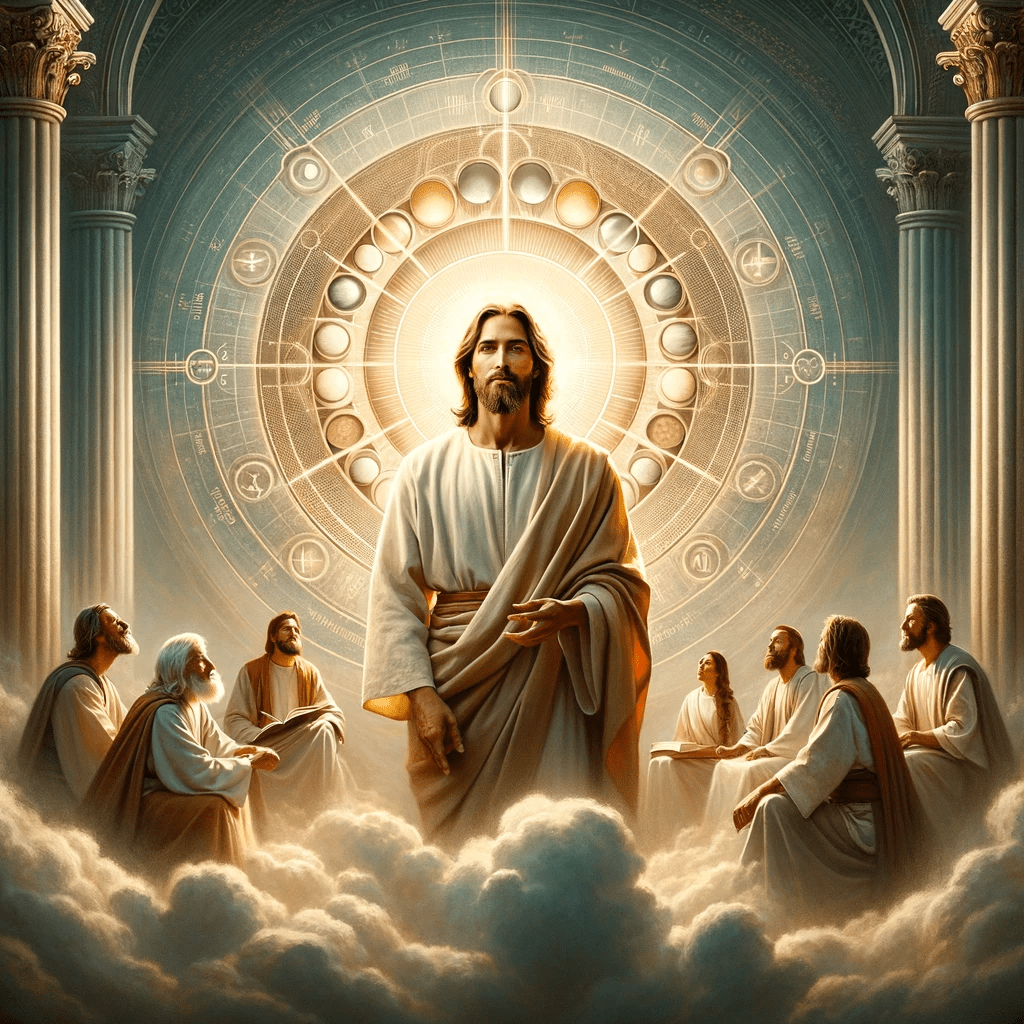
Title: “The Essence of Divine Love and Inner Transformation”
Section 1: The Living Word Within
In the dawn of existence, the essence of all life and truth, which we may call the Living Word, was one with the divine source. This essence wasn’t separate from what we know as God, for it was God in itself. Everything that exists came into being through this divine essence, and nothing that exists did so without it. Within this essence was life, and this life was the illumination for humanity, a light that shines through the darkest corners of existence, often misunderstood or unrecognized by the darkness.
Section 2: The Witness of the Inner Light
A man named John was sent as a messenger from this divine source. His purpose was to testify about this Inner Light so that through his testimony, everyone might understand and embrace it. John himself was not the Light; he was merely a witness to it. The true Light, which enlightens every person, was coming into the world. Though this Light was in the world, and the world was made through it, many did not recognize or accept it. But to all who did recognize and embrace this Light, it gave the power to realize their true nature as children of the divine source, born not just of physical means but of the divine essence itself.
Section 3: The Incarnation of Love
The Living Word took form among us, full of grace and truth, revealing the glory of pure, unconditional love, akin to that of a beloved child. This manifestation of divine love showed us the way to grace beyond the laws of old, for truth and loving-kindness came through this embodiment of the divine essence.
Section 4: The Path of Transformation
John testified about this embodiment of love, declaring its precedence and significance. Through this manifestation, we all received grace upon grace, transcending the law with the gift of unbounded love and truth. This divine essence, unseen in its totality, was made known to us through this pure expression of love and truth.
Section 5: Recognizing the Divine Within
As John spoke his truth, he clarified his role, not as the awaited savior, but as a voice preparing the way for a deeper understanding of the divine. His message was simple: make straight the path within your heart for the divine essence.
Section 6: The Revelation of Unconditional Love
John then recognized the embodiment of this divine essence, referring to it as the Lamb of God, symbolizing the release of burdens and the awakening to true love. He spoke of the Spirit descending upon this embodiment, anointing it with the divine presence, marking it as a beacon of transformative love.
Section 7: The Journey of Discipleship
As the message spread, disciples began to follow this path of love, seeking understanding and companionship in this journey. They found in this teacher, not just a master, but a living example of the divine love within each person, calling each by name into a new identity and purpose.
Section 8: The Unveiling of Inner Truth
In encounters with seekers like Nathanael, this teacher of love revealed the ability to see beyond appearances, recognizing the true nature within each individual. This recognition was not based on outer achievements but on the inner truth and potential of each person.
Section 9: The Promise of Greater Awakening
Finally, this teacher of love promised even greater revelations, hinting at a future where the connection between the divine and humanity would be clearly seen, a time when the divine essence within us all would be fully recognized and celebrated.
In this retelling, the message of love, hope, and transformation is central. It speaks to the divine essence within each of us, inviting us to awaken to our true nature, to live in alignment with unconditional love, and to transform our inner and outer worlds through this realization. This message is a call to recognize and embrace the divine light and love that resides in each of us, guiding us towards a life of deeper meaning, connection, and fulfillment.
Title: “The Journey of Inner Awakening and Divine Love”
Section 1: The Celebration of Unity
In a small village named Cana, there was a joyful celebration of marriage, a symbol of unity and love. Among the guests were a wise teacher and his followers. During the festivities, a challenge arose: the wine had run out. The teacher’s mother, recognizing the depth of his understanding, turned to him for a solution. She trusted in his wisdom and guided others to follow his instructions.
Section 2: The Transformation of the Ordinary
In this setting, there were vessels used for traditional purification, signifying the rituals that cleanse and prepare us. The teacher, seeing an opportunity to reveal a deeper truth, instructed the servants to fill these vessels with water. When they obeyed, something extraordinary happened. The ordinary water was transformed into wine, a symbol of joy and celebration. This act was not just a mere changing of elements, but a demonstration of how the most common aspects of our lives can be transformed into sources of joy and fulfillment.
Section 3: The Revelation of Inner Abundance
This transformation was first recognized by those who served, symbolizing that often, the most profound truths are seen by those who are humble and attentive. The master of ceremonies, unaware of the origin of this fine wine, praised its quality, acknowledging that the best had been saved for last. This moment marked the beginning of many such teachings by the wise teacher, revealing his understanding and inspiring belief in his followers.
Section 4: A Time of Reflection
After this event, the teacher and his companions traveled to Capernaum for a time of rest and reflection. These moments of stillness are essential on our journey, allowing us to absorb and integrate the lessons learned.
Section 5: The Cleansing of Inner Space
As the time of Passover approached, the teacher went to Jerusalem. There, he found the sacred temple cluttered with commerce and external distractions. In a symbolic act, he cleansed the temple, driving out those who had turned a place of inner reflection into a marketplace. This act was not just about the physical space but was a metaphor for the cleansing of our inner temple – the heart and mind – from the distractions and material attachments that hinder our spiritual growth.
Section 6: The Promise of Resurrection
In response to the questions about his authority, the teacher spoke of destroying this temple and rebuilding it in three days. He was not referring to the physical structure, but to the temple of his body, symbolizing the process of personal transformation and renewal. This statement foreshadowed his own journey through suffering and renewal, a path that all of us can follow in our quest for awakening and transformation.
Section 7: The Power of Belief
During this time in Jerusalem, many witnessed the teacher’s acts and started to believe in the message he conveyed. However, he understood the fickle nature of human belief, which often relies on external signs. True understanding comes from an inner awakening, a realization of the divine love and wisdom that resides within each of us.
Conclusion: The Essence of Inner Knowing
The message woven through these events is one of transformation, love, and awakening. It reminds us that within each of us lies the potential to transform the ordinary into the extraordinary, to cleanse our inner temple of distractions and attachments, and to awaken to a deeper understanding of our true nature. This journey is about recognizing the divine essence within us, a source of infinite love and wisdom, guiding us towards a life of fulfillment, unity, and compassion.
Title: “Awakening to the Divine Within: A Journey of Love and Enlightenment”
Section 1: The Inquiry of the Seeking Soul
Once, a wise and learned man, Nicodemus, approached a teacher of great insight, seeking to understand the deeper truths of existence. He recognized that the teacher’s wisdom and the wonders he performed could only come from a profound connection with the divine source. The teacher spoke of a profound transformation, saying that to truly understand the realm of higher consciousness, one must experience a rebirth of spirit and perspective.
Section 2: The Mystery of Rebirth
Nicodemus, puzzled, wondered how one could physically be born again. The teacher explained that this rebirth was not of the body, but of the spirit. It was an awakening to a new way of seeing and being in the world, transcending the limitations of the physical self and embracing a higher, more connected state of existence.
Section 3: The Wind of the Spirit
The teacher likened this spiritual rebirth to the wind – unseen, yet its presence is felt, and its origin and destination remain a mystery. This was a metaphor for the unpredictable yet transformative power of the spirit, which stirs within each person in unique ways, guiding them towards their true nature.
Section 4: The Challenge of Understanding
Nicodemus struggled to grasp these deep teachings. The teacher expressed that understanding the earthly signs is the first step, but to comprehend the heavenly truths requires an open heart and mind, ready to embrace the unseen and the profound.
Section 5: The Gift of Divine Love
The teacher shared the ultimate expression of the divine source’s love for the world: the sending of a teacher, a beacon of light and truth, to guide humanity towards enlightenment and eternal life. This was not a mission of judgment, but one of salvation, offering a path to transcend suffering and embrace the light of truth and love.
Section 6: The Choice Between Light and Darkness
This path, however, presented a choice. To follow the light and embrace truth meant to expose and transform one’s inner darkness. Those who clung to negative deeds and thoughts shied away from the light, fearing the revelation and transformation it brought.
Section 7: The Testament of John
Meanwhile, the teacher’s forerunner, John, continued his work, baptizing and preparing the way. He spoke of the greater significance of the teacher’s presence, acknowledging his role in the grand design of awakening and transformation.
Section 8: Embracing a Higher Purpose
John understood that his role was to pave the way for the greater teacher. He rejoiced in his work, knowing that his mission was part of a larger plan for humanity’s awakening. He humbly acknowledged the need to let go of personal ego and allow the higher teachings to flourish.
Section 9: The Eternal Message of Love and Life
John affirmed that the teacher, who spoke of heavenly truths and was anointed with an unlimited spirit, was the true messenger of the divine. Those who embraced his teachings would find eternal life, a state of being filled with love, peace, and profound understanding.
Conclusion: The Path of Enlightened Love
Through this dialogue and John’s testimony, the message of love, hope, and transformation is reaffirmed. It invites us to embark on a journey of spiritual rebirth, to embrace the divine light within, and to transform our lives through love and enlightenment. This journey is not just about personal salvation but about contributing to a world filled with greater understanding, compassion, and unity.
Title: “The Wellspring of Divine Connection: A Tale of Love and Transformation”
Section 1: The Journey to Understanding
As the teacher journeyed through different lands, he chose to travel through Samaria, a place often avoided due to longstanding prejudices. This act in itself was a message of breaking barriers and seeking unity.
Section 2: The Encounter at the Well
In the town of Sychar, near a well steeped in history, the teacher, weary from his travels, sat to rest. A Samaritan woman approached to draw water, and he asked her for a drink. This simple request broke the norms of the day, as Jews typically avoided any interaction with Samaritans.
Section 3: The Offering of Living Water
The woman, surprised by his request, engaged in conversation. The teacher spoke of a gift from the divine, a living water leading to eternal life. This living water was a metaphor for spiritual enlightenment and inner transformation, a source of unending fulfillment and connection with the divine.
Section 4: The Revelation of Inner Truth
As their conversation deepened, the teacher revealed his insight into her life, transcending the boundaries of normal perception. The woman recognized his profound understanding and began to see him as a prophet, a bearer of deeper truths.
Section 5: Beyond Traditional Worship
Their dialogue turned to worship and spiritual practices. The teacher emphasized that true worship was not confined to specific places or rituals but was a matter of the heart and spirit. He spoke of a time when worship would transcend physical locations and cultural divisions, focusing instead on a sincere connection with the divine.
Section 6: The Recognition of the Divine Messenger
The woman spoke of her hope for the coming of a great teacher who would reveal all truths. The teacher gently revealed that he was the one she spoke of, the messenger of divine love and wisdom.
Section 7: A Message for All
The disciples returned, surprised to find their teacher speaking with a Samaritan woman. The woman, deeply moved by the encounter, left her jar and went to the town, urging others to meet the man who knew her innermost self.
Section 8: The Harvest of Truth
As people came to see him, the teacher spoke to his disciples of a spiritual harvest, where the seeds of truth and love were ready to be reaped. He emphasized that this work was a collective effort, building upon the labors of many.
Section 9: The Awakening of a Community
Many Samaritans came to believe in the teacher’s message, not merely because of the woman’s testimony but through their personal experience of his wisdom and love. They recognized him as a savior for all humanity, transcending cultural and religious boundaries.
Section 10: The Healing of Belief
The story concludes with the teacher returning to Galilee, where he was welcomed for the wonders he performed. A nobleman approached him, pleading for the healing of his son. The teacher assured him of his son’s recovery, and the man believed. Upon returning home, he found his son well, affirming the power of faith and the teacher’s words.
Conclusion: The Flow of Divine Love
This narrative teaches us about breaking down barriers, seeking unity, and finding a deeper connection with the divine source within and around us. It speaks to the transformative power of understanding, compassion, and love. The living water represents an endless source of spiritual nourishment, guiding us toward a life of fulfillment and connection with all beings. In this journey, we learn that divine love transcends all boundaries, offering healing, hope, and enlightenment to everyone, regardless of their past or background.
Title: “The Path of Healing and Inner Revelation”
Section 1: A Gathering of Faith
As the teacher moved through the land, he arrived in Jerusalem during a festival. Near a sheep market, there was a pool named Bethesda, surrounded by five porches. Here, many who were facing physical and emotional challenges gathered, hoping for healing.
Section 2: The Pool of Bethesda
Among them was a man who had been struggling with his condition for thirty-eight years. When the teacher saw him and understood his long-standing challenge, he asked a simple yet profound question: “Do you want to be healed?”
Section 3: The Question of Desire
The man expressed his difficulties in finding help, highlighting the obstacles he faced in reaching the pool at the right moment. It was a reflection of his deep-seated belief in external sources for healing and transformation.
Section 4: The Command to Rise
The teacher, recognizing the man’s potential for inner change, instructed him to rise, take up his bed, and walk. This command symbolized the awakening of the man’s own ability to transform his life, moving beyond the constraints of his long-held condition.
Section 5: The Sabbath Controversy
The man’s healing, which occurred on the Sabbath, stirred controversy among the religious leaders. They focused on the external act of carrying the bed on a day of rest, missing the deeper significance of the healing that had taken place.
Section 6: The Inner Working of the Divine
The teacher explained that the divine source is always active, working within and through us. He emphasized the unity and interconnectedness of all actions with the divine will, transcending human-made limitations and rules.
Section 7: The Unity of Action and Will
He spoke of his actions as being in alignment with the divine purpose, reflecting a deeper understanding of life and existence. His healing works were not just miracles but manifestations of a higher consciousness at work.
Section 8: The Resurrection of Life
The teacher conveyed a powerful message about the awakening of the spirit, likening it to a resurrection from death to life. This resurrection was not a physical one but an awakening to a higher state of being, filled with love, compassion, and understanding.
Section 9: The Judgment of the Heart
His teachings emphasized the importance of inner judgment based on this higher consciousness. He sought not to please human expectations but to align with the divine will, guiding others towards this higher understanding.
Section 10: The Witness of Greater Works
He spoke of greater works than these healings, pointing towards the transformative power of love and understanding that he was bringing to humanity. These works bore witness to the divine presence within him and within all.
Section 11: The Challenge of Belief
Despite these profound teachings, many struggled to believe in him. He pointed out their reliance on external validation and their lack of understanding of the deeper truths he shared.
Conclusion: The Call to Inner Awakening
This narrative invites us to look beyond physical and external conditions and to discover the healing and transformative power within ourselves. It teaches us that true healing and enlightenment come from aligning with the divine presence within us, transcending external limitations, and embracing a path of love, hope, and transformation. This journey requires us to rise above our long-standing beliefs and conditions, opening our hearts to the deeper truths of our interconnected existence and the infinite love that sustains it.
Title: “The Essence of Life: A Journey of Spiritual Nourishment and Unity”
Section 1: The Gathering of Seekers
As the teacher traveled, a multitude followed, drawn by his teachings and the healing he brought. He journeyed to a mountain, a place of reflection and connection, as the time of Passover, a festival of renewal and liberation, approached.
Section 2: The Miraculous Feast
Facing a sea of followers, the teacher contemplated how to feed them. His question to his disciple, Philip, was a prompt for deeper understanding. Andrew, another disciple, mentioned a boy with five barley loaves and two small fish, seemingly insufficient for such a large crowd. The teacher, seeing beyond physical limitations, asked the people to sit. He gave thanks for the modest food and distributed it. Miraculously, everyone ate and was satisfied, and the leftovers filled twelve baskets, symbolizing abundance from scarcity.
Section 3: The Symbol of Divine Provision
The people, witnessing this act, recognized the teacher as a prophet. Sensing their intention to crown him by force, he withdrew to the mountain, a testament to his mission being spiritual, not political.
Section 4: The Walk on Water
As evening fell, the disciples sailed toward Capernaum. Amidst strong winds and dark waters, they saw the teacher walking on the sea, approaching their boat. His presence calmed their fears, and they reached their destination safely, symbolizing the teacher’s ability to transcend physical laws and instill peace in turbulent times.
Section 5: The Search for the Teacher
The following day, the crowd sought the teacher, crossing the sea to find him. They questioned how he arrived, but the teacher, seeing their material motivation, urged them to seek spiritual nourishment.
Section 6: The True Bread from Heaven
The people recalled their ancestors receiving manna in the desert. The teacher revealed that the true bread from heaven is that which brings eternal life. He proclaimed himself as this living bread, offering spiritual sustenance and unity with the divine.
Section 7: The Mystery of the Living Bread
The concept of eating his flesh and drinking his blood perplexed many. This metaphorical language was not about physical consumption but about fully embracing and internalizing his teachings, symbolizing a deep, transformative connection with the divine source.
Section 8: The Essence of the Spirit
As some followers struggled with these teachings, the teacher clarified that his words were spiritual, not literal. He emphasized that true life comes from the spirit, not the flesh. The essence of his message was about inner transformation and awakening.
Section 9: The Challenge of Faith
Despite his profound teachings, some disciples turned away, unable to grasp the spiritual depth. The teacher asked the twelve if they would also leave. Peter, recognizing the truth in his words, affirmed their commitment, acknowledging him as the embodiment of eternal life.
Section 10: The Acknowledgment of Betrayal
The teacher, aware of the impending betrayal by one of his own, highlighted the complexity of human nature and the challenges of truly understanding and living the spiritual path.
Conclusion: The Invitation to Spiritual Fulfillment
This narrative invites us on a journey of deep spiritual nourishment, where physical needs and limitations are transcended by a greater understanding of life’s true essence. It challenges us to look beyond material desires and to feed our souls with the teachings that bring eternal life. This journey is about realizing our interconnectedness with the divine and each other, embracing a path of love, unity, and transformative spiritual growth.
Title: “The Stream of Eternal Wisdom: Embracing the Inner Divine”
Section 1: The Reluctance to Reveal
The teacher, aware of the growing tension and misunderstanding about his teachings, chose to remain in Galilee, avoiding overt conflict. His siblings urged him to demonstrate his works openly, not yet understanding the depth of his mission.
Section 2: The Festival of Tabernacles
As the Feast of Tabernacles approached, a time of celebration and remembrance, the teacher’s family went to Jerusalem. He followed later, in a more discreet manner, reflecting his approach to sharing wisdom: gently and without seeking fame.
Section 3: The Murmurings of the Crowd
In Jerusalem, people whispered about the teacher. Opinions were divided – some saw him as a good man, others as deceptive. This division reflected the varied levels of understanding and openness to new ideas about spirituality and life.
Section 4: The Wisdom of the Teacher
Midway through the festival, the teacher entered the temple and began to teach. The depth of his understanding amazed those who heard him, as he had not received formal education in their traditional sense. His teachings were rooted in a deeper, divine wisdom.
Section 5: The Source of True Doctrine
Responding to their wonder, he clarified that his teachings were not his alone but came from the divine source. He encouraged them to seek alignment with this higher will to truly grasp the essence of his message.
Section 6: The Challenge of Legalism
The teacher faced criticism for healing on the Sabbath, which some saw as a violation of the law. He responded by highlighting the importance of understanding the spirit behind actions rather than adhering to appearances and rigid interpretations.
Section 7: The Divinity Within
In his teachings, he emphasized his connection with the divine source, inviting others to recognize this same connection within themselves. This claim stirred controversy among the religious leaders, who couldn’t reconcile his humble origins with his profound insights.
Section 8: The Offer of Living Water
On the final day of the festival, the teacher spoke of a spiritual thirst quenched by turning to him. He spoke of “rivers of living water,” symbolizing the flow of spiritual energy and enlightenment that comes from embracing the divine within.
Section 9: The Spirit Yet to Be Revealed
This living water referred to the spirit, not yet fully understood or received by the people. The teacher’s mission was to prepare them for this inner awakening.
Section 10: The Division Among the People
The crowd was divided over his identity – some recognized him as a prophet or the Messiah, while others doubted, based on their literal interpretations of scripture and prophecies.
Section 11: The Unfulfilled Arrest
Officers sent to arrest the teacher returned empty-handed, captivated by his teachings. This baffled the authorities, who dismissed the crowd’s belief in him due to their lack of legal knowledge.
Section 12: The Defense of Inquiry
Nicodemus, a member of the ruling council who had previously sought the teacher’s wisdom, advocated for a fair hearing, emphasizing the importance of understanding before judgment.
Conclusion: The Journey to Inner Understanding
This chapter invites us to move beyond surface-level judgments and to explore the deeper truths of our existence. It teaches that the divine source of wisdom and enlightenment is within us, waiting to be discovered and embraced. The teacher’s life and teachings are a call to recognize our interconnectedness with the divine, to quench our spiritual thirst with the living water of inner wisdom, and to transform our lives with love, understanding, and compassion.
Title: “The Journey to True Freedom: Embracing Inner Light and Love”
Section 1: The Encounter with Judgement
One day, the teacher was in the temple teaching when religious leaders brought a woman accused of wrongdoing before him. They asked if she should be punished according to their laws, hoping to trap him into a controversial response. Instead, he quietly reflected, then spoke: “Let the one who has never erred cast the first stone.” One by one, they left, realizing their own imperfections.
Section 2: The Gift of Forgiveness
Left alone with the woman, the teacher did not condemn her but urged her to live a life free from past mistakes. This act symbolized the power of forgiveness and the potential for personal transformation.
Section 3: The Light of the World
The teacher proclaimed himself as the light of the world, offering guidance and vision to those in darkness. This was not about physical light but a metaphor for spiritual enlightenment and understanding.
Section 4: The Challenge of Belief
Despite his profound teachings, the religious leaders doubted him, questioning his testimony. He spoke of his deep connection with the divine source, emphasizing that true judgment and understanding come from this connection.
Section 5: The Misunderstanding of His Origin
The leaders struggled to understand his origins, expecting a messiah fitting their literal interpretations. The teacher explained that his coming was not about earthly descent but a spiritual mission.
Section 6: The Promise of Liberation
He spoke of true freedom, not as physical liberation but as release from inner limitations and misconceptions. He offered a path to this freedom through adherence to his teachings.
Section 7: The Debate over Ancestry
In a heated exchange, the leaders claimed descent from Abraham. The teacher pointed out that true kinship with Abraham was not about bloodline but about actions and attitudes in line with divine love and wisdom.
Section 8: The Accusation of False Allegiance
The leaders accused the teacher of blasphemy and demonic possession, unable to grasp the depth of his connection with the divine. He defended his honor, emphasizing his commitment to reflecting the virtues of the divine source.
Section 9: The Controversy over Eternal Life
The teacher’s promise of eternal life sparked disbelief. He explained that this was not about physical immortality but a state of being in alignment with eternal truths and divine love.
Section 10: The Revelation of Timeless Existence
In response to their skepticism about his age and wisdom, he stated, “Before Abraham was, I am.” This declaration transcended physical time, indicating his spiritual existence and unity with the divine source.
Section 11: The Escape from Persecution
As tensions rose, and they sought to harm him, the teacher left the temple, passing through the crowd untouched. This departure symbolized his transcendence above earthly conflict and his unwavering commitment to his spiritual mission.
Conclusion: The Path to True Enlightenment
This narrative invites us to look beyond superficial judgments and to embrace a deeper understanding of our spiritual nature. It teaches us the power of forgiveness, the importance of inner transformation, and the realization that true freedom and enlightenment come from aligning with the divine source within us. The teacher’s life exemplifies a journey of love, compassion, and spiritual awakening, guiding us toward a life of true fulfillment and unity with the divine essence.
Title: “Illuminating the Inner Vision: A Tale of Spiritual Awakening”
Section 1: The Encounter with Blindness
While walking, the teacher saw a man blind from birth. His disciples, reflecting common beliefs of the time, wondered if the man’s condition was due to his or his parents’ mistakes. The teacher, however, saw it as an opportunity to demonstrate the transformative power of spiritual understanding.
Section 2: The Act of Healing
He made a paste with spit and dirt and applied it to the man’s eyes, instructing him to wash in the Pool of Siloam. When the man obeyed, he regained his sight, symbolizing the clearing of inner blindness through spiritual insight.
Section 3: The Confusion Among Observers
Those who knew the man as blind were astonished. Some doubted it was the same person, while others recognized him. When asked how he gained sight, the man credited the teacher, igniting curiosity and skepticism among the people.
Section 4: The Interrogation by the Pharisees
The religious authorities questioned the man about his healing. They were divided; some saw the act as a breach of the Sabbath law, while others recognized the divine power behind it. The man affirmed his belief that the teacher was a prophet.
Section 5: The Testimony of the Parents
Doubting the man’s story, the Pharisees summoned his parents, who confirmed his lifelong blindness but feared retribution for affirming the teacher’s role. They deferred back to their son for explanations, highlighting the fear that truth often evokes in those under strict dogma.
Section 6: The Challenge to the Established Order
The healed man boldly defended the teacher, challenging the leaders’ disbelief. His spiritual awakening allowed him to see beyond physical sight and understand deeper truths.
Section 7: The Expulsion from the Synagogue
For his conviction, the man was expelled from the synagogue, illustrating how spiritual awakening can lead to separation from established structures that do not understand or accept deeper insights.
Section 8: The Revelation of Spiritual Sight
When the teacher learned of the man’s expulsion, he found him and revealed his true identity as the Son of God. The man’s faith was solidified, and he worshiped the teacher, signifying his complete spiritual awakening.
Section 9: The Paradox of Seeing and Blindness
The teacher spoke of his role in bringing judgment to the world, not in a punitive sense, but as a differentiation between those who are open to spiritual truth and those who are not. This statement confounded the Pharisees, who considered themselves spiritually sighted.
Section 10: The Confrontation of Spiritual Pride
When questioned by the Pharisees about their own blindness, the teacher pointed out that their claim of sight was their downfall. Acknowledging one’s blindness is the first step to gaining true sight.
Conclusion: The Path to Inner Enlightenment
This story teaches the importance of inner vision and understanding. It shows that physical limitations can be a path to spiritual enlightenment, challenging us to look beyond our perceptions and preconceived notions. The teacher’s life and actions invite us to open our hearts and minds to a deeper understanding of ourselves and the world, leading us towards true spiritual awakening and unity with the divine essence.
Title: “The Path to Unity: Embracing the Divine Within”
Section 1: The Metaphor of the Shepherd
The teacher, while walking with his followers, shared a parable about shepherds and sheep. He explained that those who do not enter the sheepfold through the gate but climb in another way are not true guides. The true shepherd enters through the gate and is recognized by his sheep, who follow him, understanding his deeper connection and guidance.
Section 2: The True Gateway to Salvation
He declared himself as the gateway for the sheep, offering a path to salvation and abundance of life. This metaphor illustrated the need for authentic spiritual guidance, contrasting it with misleading paths that lead to harm and loss.
Section 3: The Sacrificial Shepherd
The teacher identified himself as the good shepherd, willing to sacrifice himself for the well-being of his followers, unlike a hired hand who abandons the sheep in danger. This symbolized his deep commitment to guiding and protecting those who seek truth.
Section 4: The Universal Flock
He spoke of other sheep, not of this immediate fold, whom he also must bring, emphasizing the universality of his message and the interconnectedness of all people in the pursuit of spiritual truth.
Section 5: The Oneness with the Divine
The teacher expressed his unique relationship with the divine source, explaining that his actions and sacrifice are aligned with a higher purpose. He spoke of the divine power within him to lay down and take up his life, symbolizing mastery over physical and spiritual realms.
Section 6: Division Among the Listeners
His teachings caused division among the listeners. Some accused him of being mad or possessed, while others recognized the truth and divinity in his words, especially in light of his miraculous works.
Section 7: The Feast of Dedication
During a winter festival at the temple, the teacher was questioned about his identity. He responded that his works testify to his divine mission, but many did not believe because they were not attuned to his spiritual message.
Section 8: The Eternal Life for Followers
He promised eternal life to his followers, a life beyond physical existence, rooted in spiritual awareness and unity with the divine source.
Section 9: The Assertion of Divine Unity
When accused of blasphemy for claiming unity with the divine, the teacher referenced their scriptures, which speak of humans as divine beings. He challenged their understanding of divinity and scripture, inviting them to see beyond literal interpretations.
Section 10: The Continuation of the Journey
Faced with opposition and threats, the teacher left the temple and continued his teachings in a place where John the Baptist had previously preached. Many came to him there, acknowledging the truth in his words and believing in his teachings.
Conclusion: Embracing the Divine Within
This chapter invites us to recognize the divine presence within ourselves and others. It teaches us to discern true spiritual guidance and to follow the path that leads to unity with the divine source. The teacher’s life and parables encourage us to embrace love, compassion, and understanding, guiding us toward a life of spiritual fulfillment and interconnectedness with all.
Title: “Awakening the Divine Within: A Journey of Love and Enlightenment”
Section 1: The Call of the Soul
In a town called Bethany, there lived a man named Lazarus, loved dearly by his sisters, Mary and Martha, and by Jesus. Lazarus fell gravely ill, prompting his sisters to send for Jesus, trusting in his deep bond with their brother.
Section 2: The Deeper Purpose of Life’s Challenges
Jesus, upon hearing of Lazarus’s illness, perceived a deeper purpose. He explained that Lazarus’s sickness was not just a physical ailment but a pathway to reveal the divine power within, a testament to the truth that transcends physical existence.
Section 3: Embracing the Now
Jesus stayed where he was for two days, teaching a vital lesson about embracing the present moment and trusting in the divine timing of life’s events. Despite the danger awaiting in Judea, he then decided to return, illustrating the courage to face life’s challenges head-on.
Section 4: The Illusion of Death
To his disciples, Jesus explained that Lazarus was asleep, using this as a metaphor for the temporary nature of physical death. He aimed to awaken them to a deeper understanding of life and its eternal essence.
Section 5: The Power of Faith and Belief
Upon his arrival, Jesus encountered Martha, who expressed her faith in him and the divine plan. Jesus assured her of the spiritual truth that belief in the divine essence within brings about a transcendent understanding of life and death.
Section 6: The Revelation of Eternal Life
Jesus, deeply moved by the sorrow around him, approached Lazarus’s tomb. This moment was a profound demonstration of the interconnectedness of human emotions and the divine essence. Jesus showed that even in the face of death, life’s eternal nature prevails.
Section 7: The Awakening
At the tomb, Jesus expressed gratitude for the divine presence and called Lazarus to come out, symbolizing the awakening of the soul to its eternal nature. Lazarus emerged, a living testament to the power of spiritual awakening and the illusion of death.
Section 8: The Ripple Effect of Transformation
This miraculous event stirred many hearts, leading them to believe in the divine power within Jesus. However, it also intensified the concerns of the religious leaders, who feared the loss of their influence and the potential upheaval of their structured society.
Section 9: The Unity of the Divine Essence
The high priest Caiaphas unknowingly prophesied the unifying power of Jesus’s mission – to bring together all beings in the recognition of their inherent divine nature. This prophecy highlighted the universal aspect of Jesus’s teachings and his role in the spiritual awakening of humanity.
Section 10: Retreat and Reflection
As tensions rose, Jesus retreated with his disciples to a place called Ephraim. This retreat symbolized the need for inner reflection and preparation for the transformative journey ahead.
Section 11: The Anticipation of Renewal
As the Passover approached, anticipation grew among the people. They pondered whether Jesus would attend the feast, symbolizing the collective yearning for spiritual renewal and enlightenment.
In this reinterpretation, John 11 is presented as a story of spiritual awakening, emphasizing the themes of love, hope, and transformation. It highlights the journey from physical understanding to spiritual enlightenment, underscoring the idea that within each of us lies a divine essence capable of transcending life’s greatest challenges. This narrative invites us to recognize our interconnectedness with the divine and to embrace the transformative power of love and belief in our journey toward enlightenment.
Title: “Harmony of the Soul: Embracing the Eternal Light Within”
Section 1: Reunion of Enlightened Souls
In Bethany, Jesus reunited with Lazarus, recently awakened from the sleep of death. This gathering, marked by a supper where Martha served and Lazarus sat beside Jesus, symbolized the harmonious communion of enlightened souls.
Section 2: The Act of Divine Love
Mary, in a profound act of devotion, anointed Jesus’ feet with precious ointment, filling the space with its fragrance. This act, critiqued by Judas for its material extravagance, was defended by Jesus as a preparation for his forthcoming journey, symbolizing the transcendence of material concerns in favor of spiritual devotion.
Section 3: The Ripple of Awakening
The miracle of Lazarus’s awakening attracted many, leading them not only to Jesus but also to Lazarus, symbolizing how acts of divine love and awakening can ripple outwards, touching many lives.
Section 4: The Fear of Transformation
The chief priests, troubled by the growing belief in Jesus catalyzed by Lazarus’s awakening, plotted to silence both voices. This represented the resistance often faced when transformative spiritual truths challenge established norms.
Section 5: The Entry of the Enlightened One
Jesus’ entry into Jerusalem, heralded by crowds with palm branches and cries of “Hosanna,” symbolized the welcoming of a new, enlightened consciousness into the heart of human existence.
Section 6: The Seekers of Truth
Greeks, representing seekers of universal truths, approached Jesus, indicating a growing collective desire for spiritual enlightenment that transcended cultural and national boundaries.
Section 7: The Parable of Transformation
Jesus spoke of a grain of wheat dying to produce many seeds, a metaphor for the ego’s death leading to the awakening of a higher consciousness. He emphasized the importance of service and following the path of spiritual enlightenment.
Section 8: The Voice of the Divine
A voice from heaven, heard during Jesus’ contemplation, signified the alignment of the human with the divine, reassuring the followers of the eternal presence and guidance of the divine source.
Section 9: The Call to Light
Jesus, as a beacon of light, invited all to walk in this light and become ‘children of light,’ emphasizing the choice each person has to embrace enlightenment or remain in the darkness of ignorance.
Section 10: The Challenge of Belief
Despite witnessing many miracles, some struggled to believe in Jesus. This reflected the prophecy of Isaiah, highlighting the human tendency to resist transformative truths that challenge existing beliefs.
Section 11: The Inner Conflict
Even among leaders, belief in Jesus was present, but fear of social exile prevented open acknowledgment. This underscored the conflict between the longing for spiritual truth and the desire for societal approval.
Section 12: The Essence of Belief
Jesus proclaimed that belief in him was not just belief in his physical form but in the divine source that sent him. He emphasized his role as a bringer of light to dispel darkness and as a guide to eternal truth, not as a judge but as a savior.
Section 13: The Eternal Commandment
In his closing remarks, Jesus highlighted that his teachings were not his own but those of the divine source. He spoke of a commandment that leads to everlasting life, emphasizing the importance of living in accordance with divine wisdom.
In this reinterpretation, John 12 is presented as a narrative of spiritual enlightenment and transformation. It emphasizes the inner journey towards recognizing the divine light within and the challenges faced in this path of awakening. The story highlights the importance of transcending material concerns, embracing spiritual truths, and becoming a conduit for divine love and wisdom in the world.
Title: “The Journey of Inner Awakening: A Path of Love and Unity”
Section 1: The Final Feast of Unity
Before the Passover festival, Jesus gathered with his close companions, knowing that his time to transition from the physical world was near. This gathering symbolized the culmination of his earthly journey, filled with love and dedication to his spiritual family.
Section 2: The Lesson of Humility and Service
During the meal, Jesus, in a profound act of humility and service, washed the feet of his disciples. This act, initially met with resistance by Peter, symbolized the dissolution of hierarchical structures and the importance of serving each other in love and humility. Jesus’ actions illustrated that true leadership and spiritual maturity are rooted in the willingness to serve and uplift others.
Section 3: The Teaching of Mutual Care
Jesus explained the significance of his actions, emphasizing the importance of caring for one another as he had cared for them. This act was a call to dissolve ego, embrace humility, and engage in acts of unconditional love, signifying the path of true discipleship.
Section 4: The Foretelling of Betrayal
Amidst the tranquility of the gathering, Jesus expressed his troubled spirit, revealing the impending betrayal by one of his own. This moment symbolized the human struggle between lower desires and higher spiritual truths.
Section 5: The Symbolism of the Sop
When Jesus handed a piece of bread to Judas, it symbolized the activation of Judas’ role in the greater cosmic plan. This act was not just a moment of betrayal but also a necessary step in the unfolding of a deeper spiritual journey.
Section 6: The Departure of Judas
Judas’ departure into the night represented the descent into one’s own shadow, facing the parts of ourselves that are disconnected from the divine light.
Section 7: The Declaration of Divine Glory
Jesus spoke of his glorification through God, symbolizing the unity and interconnection between the human and divine. This glorification was not about personal elevation but about the revelation of divine presence within and among all.
Section 8: The New Commandment of Love
Jesus imparted a new commandment to his followers: to love one another as he loved them. This commandment was the essence of his teachings, a call to transcend traditional religious laws and enter into a space of heart-centered living, fostering a community of love, empathy, and mutual support.
Section 9: The Path of Following
Peter’s eagerness to follow Jesus, even to the point of death, was met with a gentle forewarning of his future denial. This interaction highlighted the complexities of human commitment and the often-overlooked frailties within our noblest intentions.
In this retelling, John 13 is transformed into a narrative that emphasizes the inner spiritual journey towards awakening and enlightenment. It underscores the importance of humility, service, unconditional love, and the recognition of our interconnectedness. The chapter becomes a guide on how to live in alignment with higher spiritual truths, embracing both the light and shadow within ourselves and others.
Title: “Pathways to Inner Peace: Embracing the Divine Within”
Section 1: Tranquility of the Heart
In a time of uncertainty, Jesus imparted a message of calm and trust. He urged his followers to find peace within, mirroring the trust they place in the Divine. This teaching emphasized the interconnectedness of all things and the presence of the Divine within each individual.
Section 2: The Many Mansions of the Soul
Jesus spoke of the infinite realms within the Divine, symbolizing the vast potential and diverse experiences available within the human spirit. He assured them of a personal journey of preparation and growth, indicating an ongoing evolution of the soul.
Section 3: The Way of Truth and Life
In response to Thomas’ confusion about the path ahead, Jesus declared himself as a symbol of truth, life, and enlightenment. This statement was not about exclusivity but about embodying a way of being that aligns with the deepest truths and the essence of life itself.
Section 4: The Union of the Divine and the Self
Philip’s request to see the Divine was met with the revelation that to know Jesus was to know the Divine. This teaching emphasized the unity of all existence and the divine nature inherent in every individual.
Section 5: The Manifestation of Works Through Faith
Jesus encouraged belief in the interconnectedness of all beings, suggesting that through this understanding, greater works and deeper understanding would be possible. This belief was not just in his individual identity but in the shared divine essence.
Section 6: The Promise of the Comforter
Jesus spoke of another Comforter, the Spirit of Truth, which would dwell within them. This Comforter symbolized the ongoing presence and guidance of the Divine within each person, accessible to those who are attuned to their inner truth.
Section 7: The Oneness of Divine Presence
In a powerful declaration, Jesus revealed the interconnectedness of all – he in the Divine, and they in him. This mutual indwelling highlighted the non-duality of existence and the universal nature of divine love and presence.
Section 8: The Manifestation of Love Through Obedience
The manifestation of divine presence was linked to the expression of love through following inner guidance. This obedience was not about adherence to external rules but about aligning with the inner truth and divine love.
Section 9: The Peace Beyond the World
Jesus differentiated the peace he offered from worldly peace, emphasizing an inner tranquility that transcends external circumstances. This peace was a state of being rooted in deep understanding and connection with the Divine.
Section 10: The Reassurance of Return
Though speaking of his physical departure, Jesus reassured his followers of his return, symbolizing the cyclical nature of spiritual presence and the ongoing connection between the divine and the earthly realms.
Section 11: The Triumph Over Worldly Power
In his final words, Jesus expressed confidence in the face of worldly challenges, symbolizing the triumph of spiritual truth over material illusions. This victory was a testament to the power of divine love and the irrelevance of worldly power in the face of spiritual truth.
In “John 14,” the message is transformed into a guide for spiritual awakening and understanding the divine essence within each individual. It serves as a reminder of the transformative power of love, the importance of inner peace, and the interconnectedness of all existence. This reinterpretation invites individuals to explore their inner worlds, embrace their divine nature, and live in alignment with the deepest truths of love and unity.
Title: “The Unifying Vine: A Journey of Inner Connection and Love”
Section 1: The Symbol of the Vine
Jesus introduced the metaphor of a vine to illustrate the interconnectedness of all life. He represented himself as the central vine, a conduit of divine energy, and his followers as branches. This symbolized the essential unity and interdependence of all beings in the tapestry of life.
Section 2: Nurturing the Spiritual Growth
The narrative of pruning the branches that do not bear fruit symbolizes the process of inner transformation. It’s an allegory for letting go of unproductive thoughts and behaviors, encouraging growth towards a more fruitful, spiritually enriched life.
Section 3: Abiding in Unity
Jesus emphasized the importance of remaining in this state of connectedness, as a branch is to a vine. This teaching conveyed the idea that individual well-being is deeply linked to staying connected with the divine source and the collective consciousness.
Section 4: The Source of Fruitful Existence
He explained that the key to a rich and meaningful life is this deep connection with the divine. Without this connection, one is like a withered branch, unable to realize their full potential or contribute meaningfully to the world.
Section 5: The Cycle of Divine Love
This section emphasized the flow of love from the divine to Jesus, and from Jesus to humanity. It encouraged adherents to continue in this love, creating a perpetual cycle of love and positive energy.
Section 6: The Commandment of Love
The central commandment, according to Jesus, was to love one another as he loved them. This universal love transcends traditional norms, aiming for a higher understanding and expression of love that fosters unity and understanding among all people.
Section 7: The Friendship with the Divine
Jesus elevated his followers from the status of servants to friends, sharing with them the knowledge he had. This symbolizes a deeper, more personal relationship with the divine, based on mutual understanding and respect rather than hierarchy.
Section 8: The Chosen Path of Fruitfulness
The followers were chosen and ordained to lead lives that bear lasting fruit, symbolizing actions and thoughts that have a positive, enduring impact on the world. This fruitfulness is linked to the divine, ensuring their efforts are supported and magnified.
Section 9: Facing Worldly Challenges
Jesus acknowledged that his teachings might bring conflict with worldly values but encouraged steadfastness. This part of the narrative emphasizes the importance of staying true to one’s inner guidance, even in the face of opposition or misunderstanding.
Section 10: The Coming of the Spirit of Truth
The promise of the Comforter, or the Spirit of Truth, is a reassurance of ongoing divine guidance and support. This spirit is a representation of the continuous presence of the divine in the lives of believers, guiding and enlightening them on their spiritual journey.
In this reinterpretation of John 15, the focus is on the deep connection between the individual, the divine, and the collective consciousness. It emphasizes the transformative power of love, the importance of inner growth and fruitfulness, and the perpetual presence of divine guidance. This message inspires a journey towards realizing one’s divine nature and contributing positively to the collective well-being.
Title: “Inner Truths and Universal Love: A Journey of Enlightenment”
Section 1: Forewarning of Challenges
Jesus spoke candidly about the upcoming challenges and misunderstandings his followers would face. He predicted that they would be ostracized for their beliefs, emphasizing that such adversity stemmed from a lack of understanding of the divine nature within themselves and others.
Section 2: The Necessity of Transformation
He explained the necessity of his departure as a catalyst for spiritual growth and the coming of the Comforter. This symbolizes the idea that sometimes, separation or loss is necessary for deeper truths and inner strength to emerge.
Section 3: The Role of the Comforter
Jesus introduced the concept of the Comforter, or the Spirit of Truth, as an eternal guide towards inner wisdom. This represents the ongoing process of spiritual awakening and the uncovering of deeper truths within oneself.
Section 4: The Promise of Insight and Understanding
He assured them that this Spirit of Truth would provide them with the understanding they lacked at that moment, helping them to see the deeper significance of his teachings and their experiences.
Section 5: The Transformation of Sorrow into Joy
Jesus compared the temporary sorrow his followers would feel to the pain of childbirth, leading to the joy of new beginnings. This metaphor speaks to the transformative power of enduring life’s challenges, leading to spiritual rebirth and deeper joy.
Section 6: Direct Access to the Divine
He spoke of a time when they would no longer need intermediaries to understand the divine. This emphasizes the belief in direct, personal access to divine wisdom and guidance, available to all who seek it with a sincere heart.
Section 7: The Assurance of Divine Love
Jesus reassured his followers of the Father’s love for them, affirming that this love was not conditional on his physical presence. He highlighted that their belief in his teachings connected them directly to the divine source of love.
Section 8: Clarity and Affirmation of Faith
As his disciples began to understand his message more clearly, Jesus acknowledged their growing faith. He emphasized that true understanding comes from within and does not always require external validation.
Section 9: The Inevitable Moment of Trial
He warned of a time when they would feel alone and scattered, reminding them that even in solitude, they are never truly alone. This speaks to the inner presence of the divine that remains with them regardless of external circumstances.
Section 10: The Triumph of Inner Peace
In his concluding remarks, Jesus offered a message of hope and resilience. He encouraged them to find peace within themselves, assuring them that despite the tribulations of the world, the inner strength and understanding they had gained would help them overcome any adversity.
In this reinterpretation of John 16, the focus is on the inner journey towards enlightenment and understanding. It highlights the importance of facing challenges as opportunities for growth, the continuous presence of divine guidance, and the transformative power of love and inner peace. This message inspires believers to find strength and wisdom within themselves and to connect with the universal source of love and truth.
Title: “Unity in Divine Essence: A Prayer for Oneness and Enlightenment”
Section 1: Invocation for Divine Unity
In this profound moment, the teacher looked towards the heavens, speaking of the interconnectedness of all beings. He acknowledged the divine source within and expressed his role in manifesting this divine essence on Earth. This is a call for recognition of our shared essence and the unifying force of the divine.
Section 2: The Gift of Eternal Understanding
He spoke of eternal life, not as a continuation of physical existence, but as a deep, enduring understanding of the divine truth. This understanding transcends traditional concepts of life and death, offering a pathway to spiritual enlightenment.
Section 3: Manifestation of Divine Purpose
The teacher reflected on his mission to reveal the divine essence within humanity. He emphasized the completion of his work, having successfully awakened this understanding in those who were ready to receive it.
Section 4: Prayer for the Protectors of Truth
He prayed for those who had embraced the divine essence, asking for their protection and unity. This symbolizes the importance of spiritual community and the collective journey towards enlightenment.
Section 5: The Joy of Divine Truth
He expressed a desire for his followers to experience the fullness of joy found in understanding the divine essence. This joy comes from realizing one’s true nature and the interconnectedness of all existence.
Section 6: Remaining in the World as Enlightened Beings
The teacher asked for his followers to be kept safe, not by removing them from the world, but by protecting them from negativity and misunderstanding. This speaks to the idea of living in the world with a heightened sense of awareness and purpose.
Section 7: Sanctification through Truth
He spoke of sanctifying oneself through the pursuit of truth, emphasizing the transformative power of understanding the deeper realities of existence.
Section 8: Unity as the Ultimate Purpose
The teacher expressed his vision for all to become one with the divine essence, just as he was one with it. This unity is the ultimate goal of spiritual awakening, where individual consciousness merges with universal consciousness.
Section 9: Sharing the Divine Glory
He shared the glory he received from the divine source with all, symbolizing the shared nature of enlightenment and the collective journey towards spiritual awakening.
Section 10: The Final Request for Unity and Love
In his final thoughts, the teacher asked for all to experience the divine love and unity he had known. This is a call for a collective awakening to the truth of our interconnectedness and the boundless love that underpins all existence.
In this reinterpretation of John 17, the emphasis is on the deep spiritual connection we all share with the divine source and each other. It highlights the journey towards understanding our true nature, the power of unity and love, and the transformative effect of recognizing the divine essence within us all. This message encourages us to embrace our spiritual journey, connect deeply with others, and realize our potential for collective enlightenment.
Title: “The Journey Through Shadows: Embracing Inner Light in Times of Trial”
Section 1: The Onset of Betrayal
As the teacher and his followers traversed a familiar path, they were confronted by a former ally, Judas, who led a group armed with intent to capture. The teacher, aware of the impending events, faced this challenge head-on, embodying the strength found in understanding one’s path and destiny.
Section 2: The Symbolic Gesture of Resistance
In a moment of tension, a follower, acting out of protective instinct, resorted to physical resistance. However, the teacher, emphasizing the path of non-violence and acceptance, reminded him that every experience, even the most challenging, is a part of the journey towards enlightenment.
Section 3: The Questioning by Authorities
Brought before the religious authorities, the teacher spoke of his teachings being open and accessible to all, emphasizing the transparency of his message and the importance of seeking truth openly and honestly.
Section 4: The Denial of Association
As the night progressed, a close follower, Peter, found himself denying any connection to the teacher, reflecting the human tendency to succumb to fear and societal pressure. This act symbolizes the inner conflict between our higher ideals and our often fear-driven actions.
Section 5: The Confrontation with Pilate
The teacher was presented to Pilate, the local governor, who questioned him about his identity and purpose. In this dialogue, the teacher spoke of a kingdom not of this world, highlighting the distinction between material and spiritual realms and the sovereignty of the inner self.
Section 6: The Nature of Truth
In response to Pilate’s inquiry about truth, the teacher implied that truth is not a static concept but a living, experiential reality that is recognized by those aligned with their inner selves. This interaction signifies the eternal quest for understanding and the realization that truth is a deeply personal journey.
Section 7: The Reflection on Innocence
Pilate, after questioning the teacher, found no fault in him, yet he was swayed by the demands of the masses, illustrating how external pressures and societal norms can often override personal judgment and moral integrity.
Section 8: The Choice of the People
The crowd, given the choice to free the teacher or a known criminal, chose to free the latter. This moment reflects the collective consciousness in a state of confusion, often choosing the familiar over the transformative.
In “The Journey Through Shadows: Embracing Inner Light in Times of Trial,” the narrative of John 18 is reimagined to emphasize the themes of inner strength, truth-seeking, and the trials one faces on the path to spiritual enlightenment. It portrays the teacher as a figure embodying peace, acceptance, and a deep understanding of the human journey. This reinterpretation invites readers to reflect on their inner conflicts, societal influences, and the transformative power of facing challenges with a sense of higher purpose and connection to the divine within.
Title: “The Final Act of Love: A Journey of Transformation and Unity”
Section 1: The Prelude to Transformation
In a profound display of human drama, the teacher, symbolizing the inner self, faced extreme trials. He was subjected to physical and emotional challenges by those who could not understand his message of universal love and unity.
Section 2: The Crown of Thorns and the Purple Robe
Symbolic elements like the crown of thorns and the purple robe were used to mock the teacher, representing the pain and mockery that truth and love can face in a world of misunderstanding. This act reflects our own internal struggles with accepting the higher truths of our existence.
Section 3: Pilate’s Dilemma
Pilate, the figure of authority, found himself in a moral quandary, torn between his sense of justice and the pressure of the masses. This reflects our own inner conflict between doing what is right and succumbing to external pressures.
Section 4: The Path to Crucifixion
The teacher’s journey towards crucifixion symbolizes the ultimate sacrifice of the self for the greater good. It represents the idea that true transformation often comes through suffering and the relinquishing of the ego.
Section 5: The Symbolism of the Garments
The soldiers’ actions of dividing the teacher’s garments and casting lots for his seamless robe symbolize the human tendency to focus on the material and superficial, missing the deeper, unifying essence of spiritual teachings.
Section 6: The Final Moments and Words
As the teacher hung on the cross, he saw his mother and a beloved disciple, symbolizing the interconnectedness of all beings. His final act of ensuring their care for each other reflects the enduring nature of love and the importance of nurturing relationships.
Section 7: Fulfillment of Prophecy
The teacher’s final moments, including his thirst and the piercing of his side, fulfilled ancient prophecies. This signifies that every life experience, even the most painful, has a purpose and place in the larger tapestry of existence.
Section 8: The Burial and the New Sepulchre
The teacher’s burial in a new sepulchre, prepared by his secret followers, signifies the planting of a seed for new growth and understanding. It represents the idea that from death comes new life, and from the end of one journey begins another.
In “The Final Act of Love: A Journey of Transformation and Unity,” the narrative of John 19 is reimagined to emphasize themes of sacrifice, inner conflict, and the transformative power of love and unity. It portrays the teacher’s trials and crucifixion as a metaphor for the human journey towards enlightenment, highlighting the idea that true understanding and unity can arise from the depths of suffering and sacrifice. This reinterpretation invites readers to reflect on their own inner struggles and the transformative power of love and selflessness.
Title: “The Dawn of Spiritual Enlightenment: A New Understanding”
Section 1: The Empty Tomb – A Symbol of Renewal
Early in the morning, Mary Magdalene found the tomb empty. This symbolizes the awakening of the human consciousness to a new understanding, where the physical limitations are transcended, and a higher spiritual reality is realized.
Section 2: The Disciples’ Quest for Truth
Peter and the beloved disciple’s race to the tomb represents humanity’s search for truth and enlightenment. Their varying responses upon reaching the tomb reflect different stages of spiritual awakening and comprehension.
Section 3: Mary’s Encounter – The Recognition of the Inner Self
Mary, standing outside the tomb, weeping, signifies the struggle of the human soul in the face of loss and the unknown. Her encounter with the angels, and later with Jesus, whom she initially doesn’t recognize, symbolizes the gradual recognition and acceptance of the divine presence within.
Section 4: The Revelation to Mary
When Jesus addresses Mary by name, it symbolizes the personal and intimate nature of spiritual awakening. It signifies the moment of realization that the divine is not separate from us but is an integral part of our being.
Section 5: The Message of Ascension
Jesus’ message to Mary about ascending to “my Father and your Father” emphasizes the universal nature of the divine. It suggests that we are all interconnected and part of a greater whole, and that spiritual ascension is a journey back to this oneness.
Section 6: The Gift of Peace and Understanding
Jesus’ appearance to his disciples, offering peace and showing his wounds, symbolizes the transcendence of physical suffering and the imparting of spiritual peace and understanding. It represents the idea that true peace comes from within and is available to all, regardless of external circumstances.
Section 7: Thomas’ Doubt and Belief
Thomas’ initial doubt and subsequent belief upon seeing Jesus exemplify the journey from skepticism to faith. It teaches that belief and understanding often come after experiencing the divine presence in our own lives.
Section 8: The Essence of Belief
Jesus’ blessing for those who believe without seeing emphasizes the importance of faith and inner knowing. It suggests that spiritual truth often lies beyond the realm of physical senses and can be accessed through intuition and inner connection.
Section 9: The Purpose of the Teachings
The closing remarks highlight the purpose of these spiritual teachings – to lead us to believe in our divine nature and to find life through this belief. It underscores the idea that spiritual enlightenment is accessible to all and that it offers a path to a more fulfilling and connected existence.
In “The Dawn of Spiritual Enlightenment: A New Understanding,” John 20 is reinterpreted to focus on themes of spiritual awakening, inner transformation, and the realization of our interconnectedness with the divine. It portrays the events surrounding the resurrection as a metaphor for the human journey towards enlightenment, emphasizing the power of faith, the importance of inner peace, and the universal nature of the divine. This reinterpretation encourages readers to explore their own spiritual path and to find deeper meaning and connection in their lives.
Title: “The Journey Within: Discovering the Infinite Love”
Section 1: A New Dawn at Tiberias
The disciples’ return to fishing symbolizes humanity’s tendency to revert to familiar patterns, even after transformative experiences. The barren night of fishing represents the futility of seeking fulfillment in external pursuits without spiritual guidance.
Section 2: The Guiding Light on the Shore
The appearance of Jesus on the shore, unrecognized at first, reflects the often unnoticed presence of the divine in our daily lives. His guidance to cast the net on the right side symbolizes the shift in perspective required to truly understand and embrace spiritual wisdom.
Section 3: The Abundance of Spiritual Fulfillment
The miraculous catch of fish symbolizes the abundance and fulfillment that comes from following spiritual guidance. It illustrates that when we align with our inner divinity, we experience the richness of life in ways we never thought possible.
Section 4: The Sacred Communion
The shared meal of fish and bread on the shore represents communion, not just with Jesus but with the divine essence within each individual. It signifies nourishment of the soul and the shared spiritual journey of humanity.
Section 5: The Dialogue of Love and Service
Jesus’ conversation with Simon Peter about love and feeding his sheep symbolizes the importance of love as the foundation for service to others. It teaches that true love leads to action and caring for the well-being of others, reflecting our interconnected nature.
Section 6: The Path of Unconditional Love
Peter’s distress at Jesus’ repeated questioning about his love reflects the human struggle to understand and embody unconditional love. Jesus’ insistence highlights the essential role of love as the core of spiritual growth and service.
Section 7: Embracing Our Life’s Journey
Jesus’ prophecy about Peter’s old age and the manner of his death symbolizes the acceptance of one’s life journey, including its challenges, as a path to spiritual enlightenment. It teaches that each individual’s path is unique and divinely guided.
Section 8: The Focus on Our Own Path
The discussion about the fate of the beloved disciple emphasizes the importance of focusing on our own spiritual path without being distracted by comparisons or the journeys of others. It teaches the value of personal growth and introspection.
Section 9: The Infinite Teachings of Love
The closing remarks acknowledge the vastness of Jesus’ teachings and actions, symbolizing the infinite nature of divine love and wisdom. It suggests that the essence of spiritual truth is too expansive to be fully captured in words or texts, inviting continuous exploration and discovery.
In “The Journey Within: Discovering the Infinite Love,” John 21 is reinterpreted to emphasize the themes of spiritual awakening, the journey towards unconditional love, and the recognition of our interconnectedness with the divine. It portrays the post-resurrection appearances of Jesus as lessons in understanding and living a spiritually fulfilled life, centered on love, service, and personal growth. This reinterpretation encourages readers to embark on their own journey of inner discovery, guided by the principles of love and interconnectedness with all of existence.

Here is the image depicting the biblical scene where Jesus is speaking to Nathanael under a fig tree in a tranquil garden, with the heavens opening up and angels ascending and descending. This artistic representation captures the divine encounter and the awe-inspiring moment as described.

Here is the image depicting the scene that symbolizes the promise of greater revelations about the connection between the divine and humanity, as you described. The drawing captures a serene and ethereal environment with a teacher of love and people of various ages and backgrounds, all in a moment of spiritual awakening and unity.
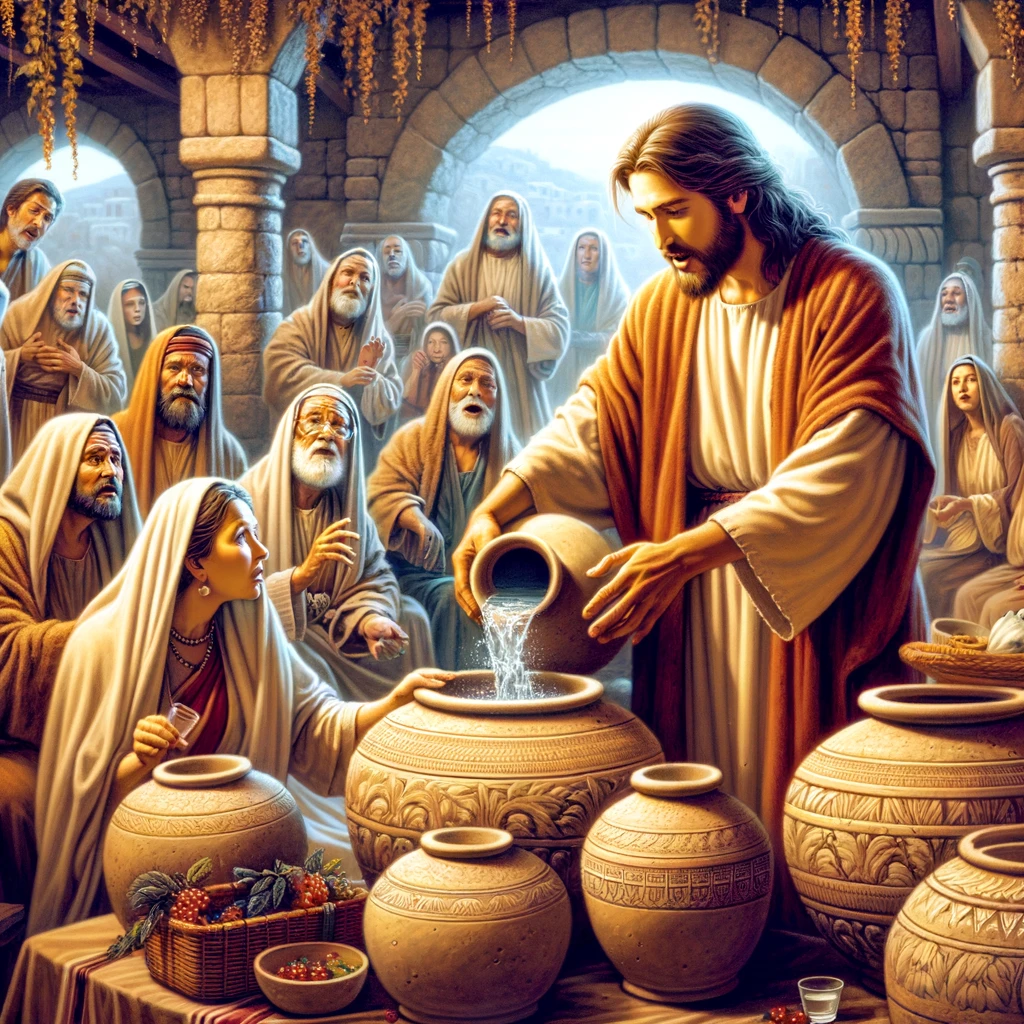
Here is the image depicting the biblical scene of Jesus changing water into wine at a wedding in Cana, capturing the moment of miracle and the reactions of those present.
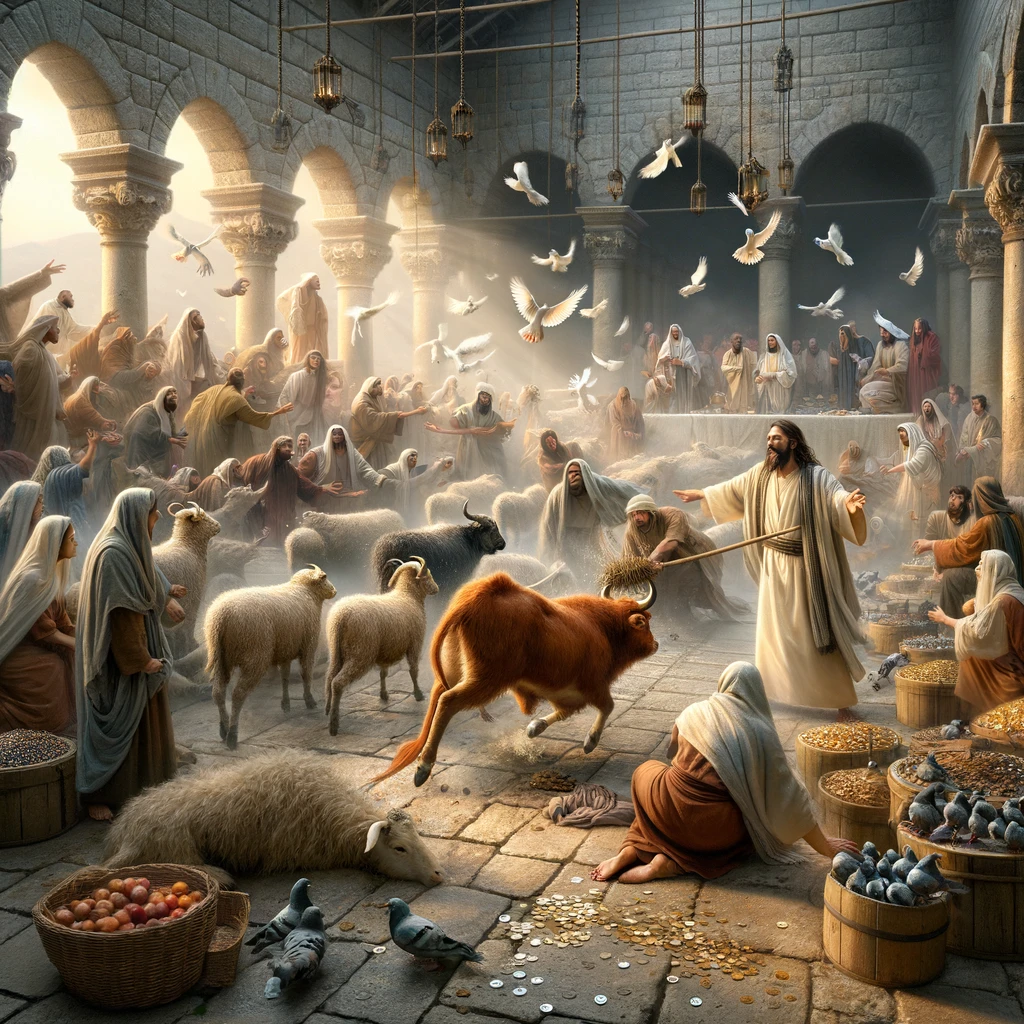
Here is the image depicting the biblical scene of the First Passover, where Jesus cleanses the temple in Jerusalem. The scene vividly captures the dramatic moment and the reactions of those present.

Here is the image depicting the scene of Jesus cleansing the temple in Jerusalem, with an intense and dynamic portrayal of him flipping a table over with a whip, sending coins and doves flying everywhere. The image captures the fervor and zeal of the moment.
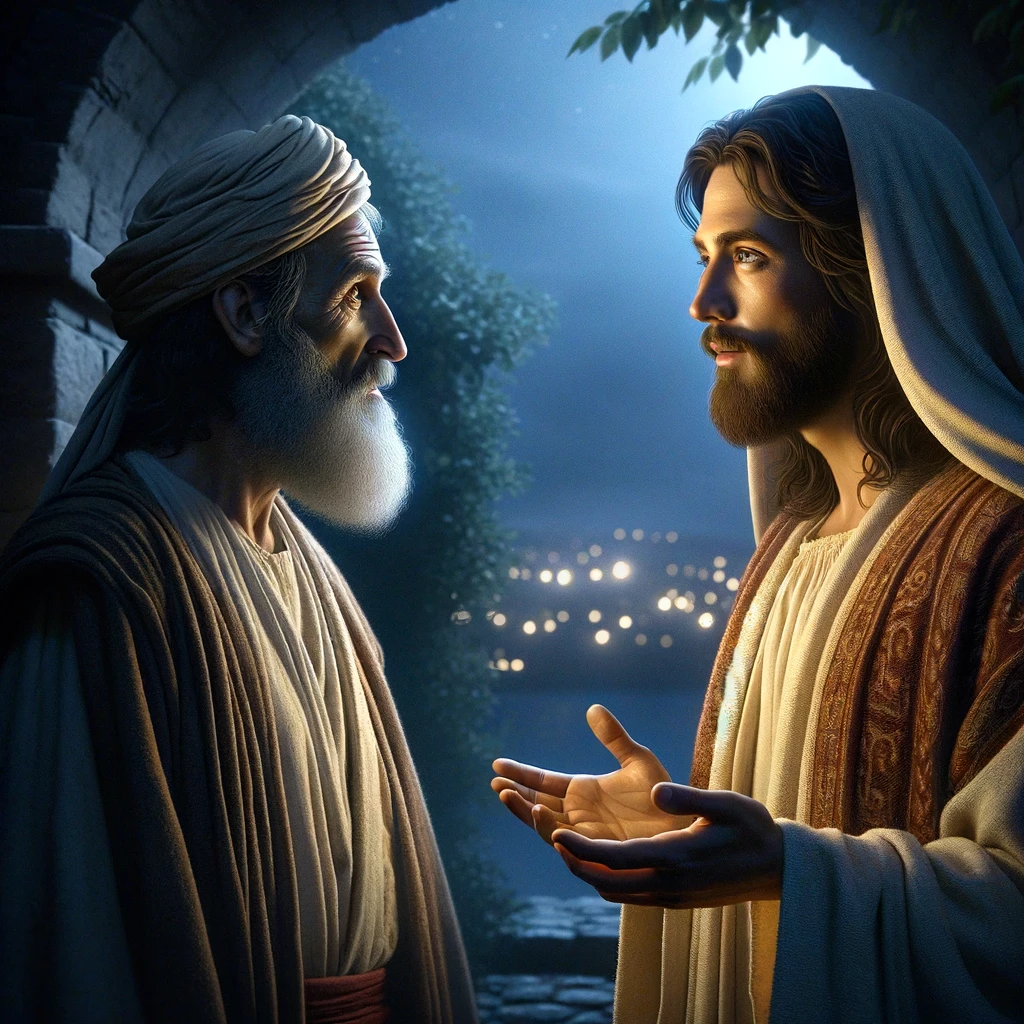
Here is the image depicting the biblical scene of Nicodemus meeting Jesus at night. The scene captures their profound and respectful conversation in a nocturnal setting.

Here is a symbolic and respectful interpretation of the biblical concept you described, focusing on the themes of hope, salvation, and the triumph of light over darkness. This image portrays a serene landscape at dawn, with the first rays of sunlight breaking through the darkness and illuminating a path towards a distant, radiant light.

Here is the image depicting John the Baptist and Jesus performing baptisms by a river, as described in the biblical context. The scene is set in a serene, natural riverside setting, with a focus on the spiritual significance of the event.
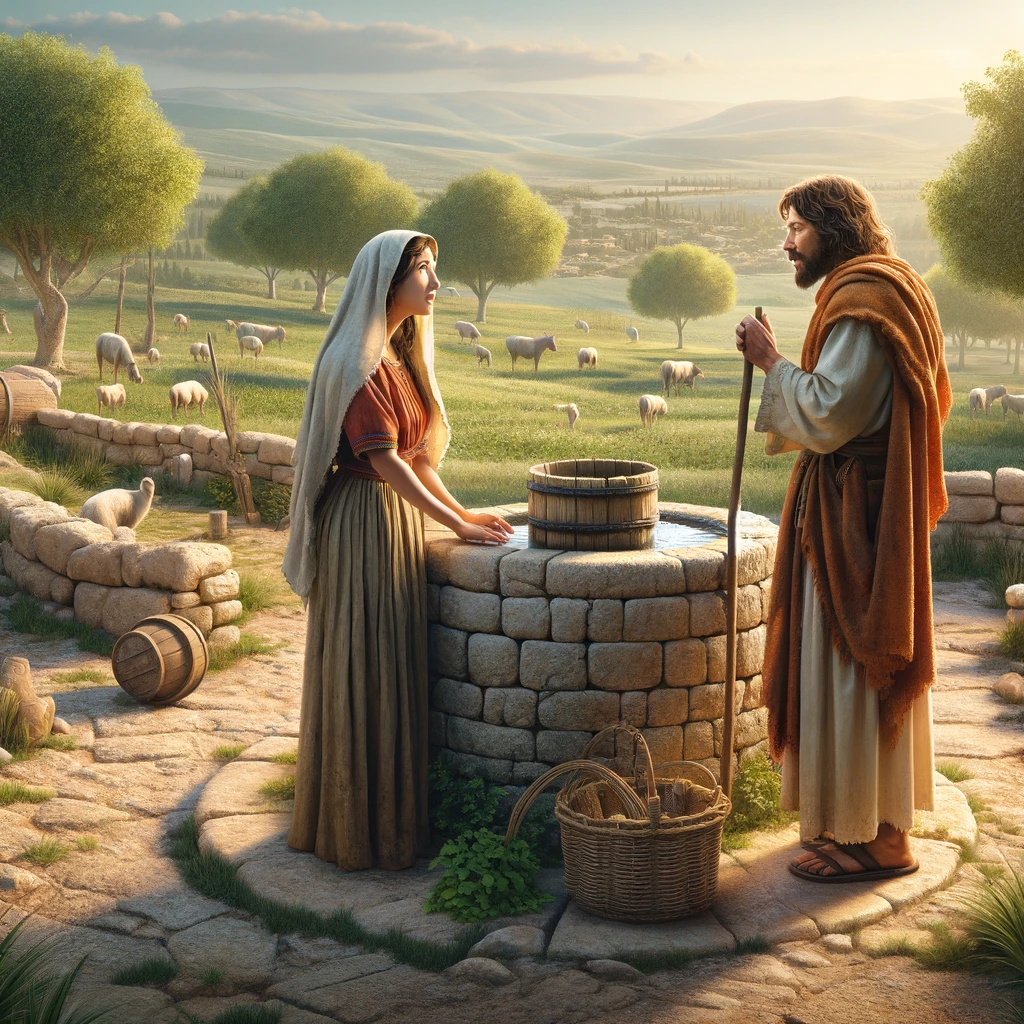
The image has been created, capturing the moment of conversation between the Samaritan woman and Jesus at the well, set in a serene outdoor environment in Samaria. The focus is on their facial expressions and the historical context of the scene.

The image now depicts the biblical scene of the woman of Samaria and Jesus at the well, set in a serene outdoor environment with fields and trees nearby. The scene captures the peaceful interaction within this tranquil natural setting.
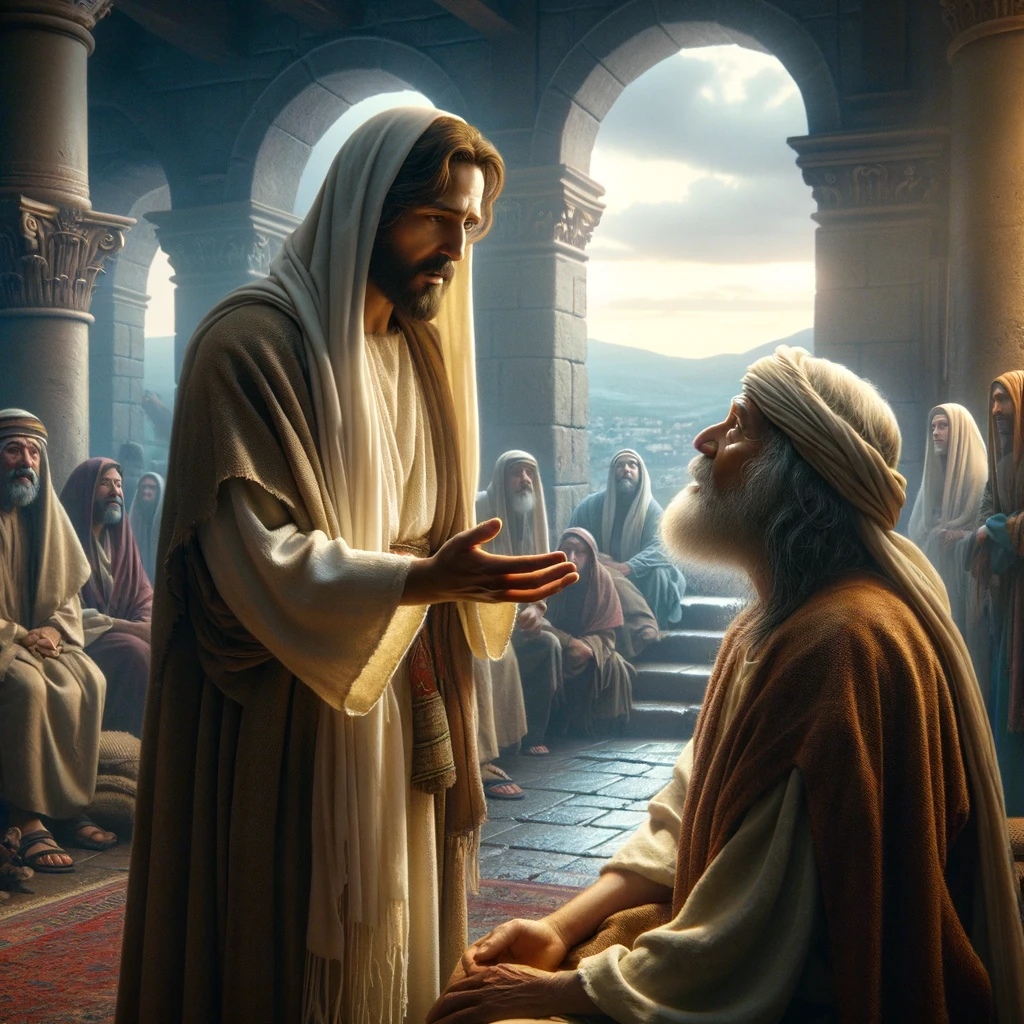
The image depicting the biblical scene where Jesus heals the official’s son in Cana, Galilee, has been created. It focuses on the moment of their interaction, set against the historical backdrop of Cana.
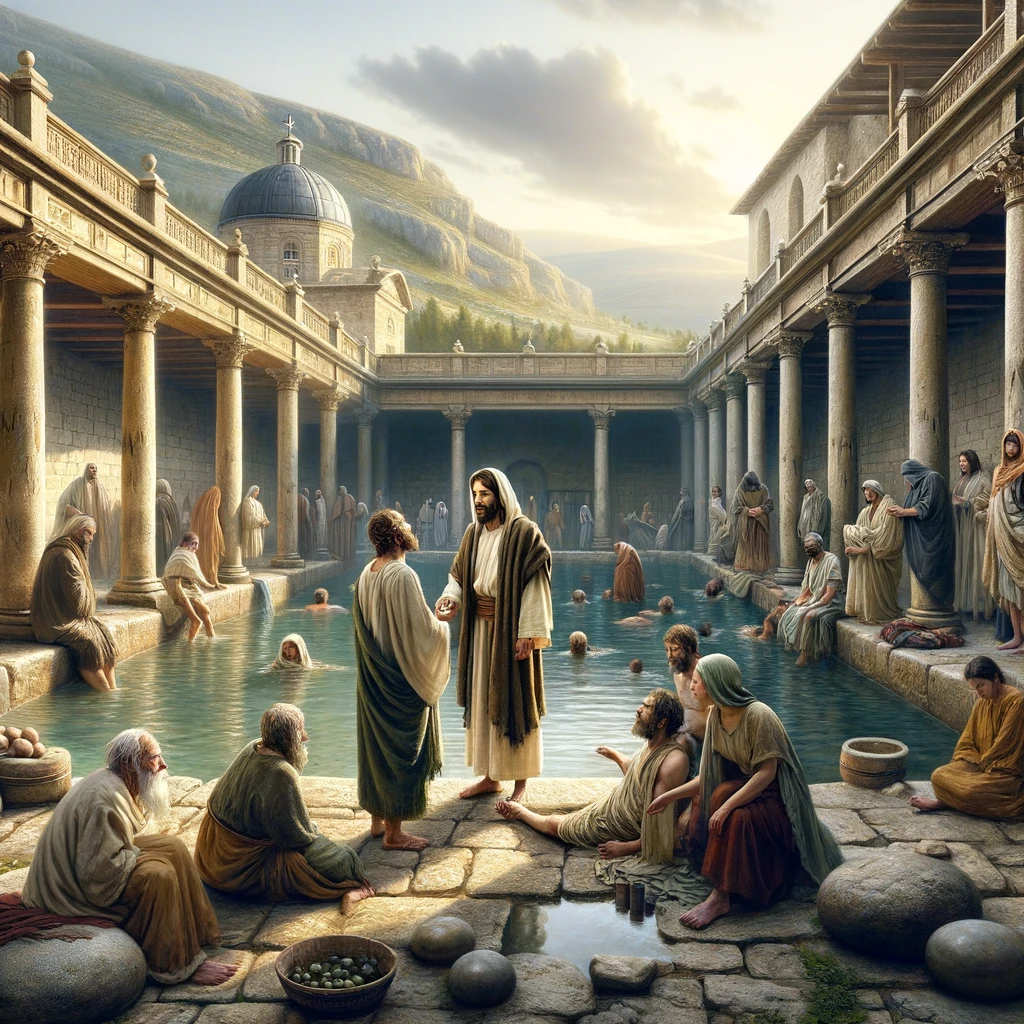
The image depicting the biblical scene of the Healing at the Pool of Bethesda in Jerusalem has been created. It captures the setting near the Sheep Gate with its covered colonnades and the significant moment of interaction between Jesus and the invalid.

The image has been created, capturing the moment in the biblical story where Jesus heals the invalid at the Pool of Bethesda. It portrays the transformation as the invalid, filled with astonishment and joy, stands up and picks up his mat, following Jesus’ command.

The image depicting the biblical verse about resurrection and judgment has been created. It captures the symbolic moment of figures rising from their graves in response to a divine voice, set in a serene yet profound landscape.

The image has been created, capturing the essence of the metaphorical concepts of ‘The Resurrection of Life’ and ‘The Judgment of the Heart’. It portrays a figure in a state of spiritual awakening and enlightenment, symbolizing the transition to a higher state of being and inner judgment aligned with the divine will.
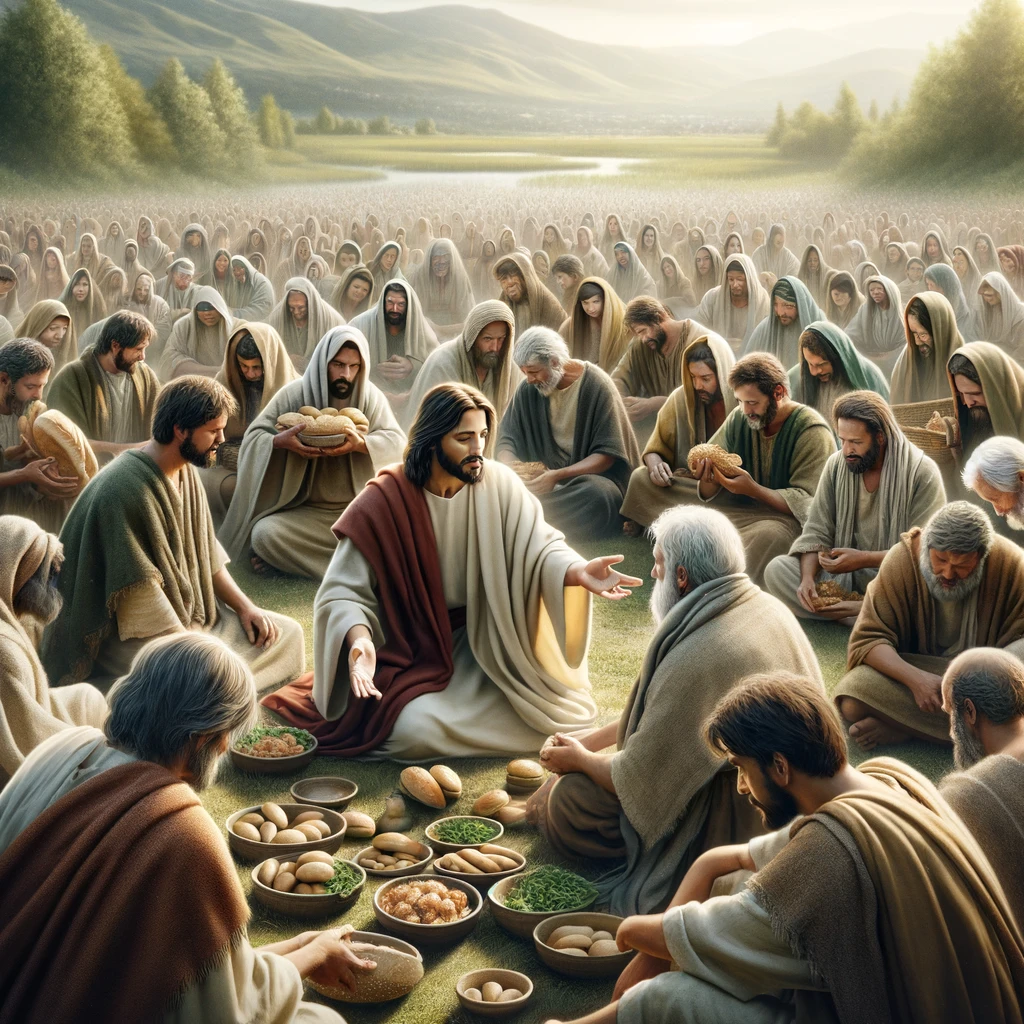
The image depicting the biblical scene where Jesus feeds the five thousand has been created. It portrays Jesus at the center of a large crowd, blessing and distributing loaves and fish, set in a peaceful outdoor setting with plenty of grass.

An image capturing the scene of ‘The Walk on Water’ has been created. It depicts the teacher walking calmly on the sea amidst a stormy evening, approaching the disciples’ boat, symbolizing his ability to bring peace in turbulent times.

The image illustrating ‘The Mystery of the Living Bread’ has been created. It symbolically portrays the concept of spiritual nourishment and the deep, transformative connection with the divine source, focusing on the metaphorical rather than the literal interpretation.
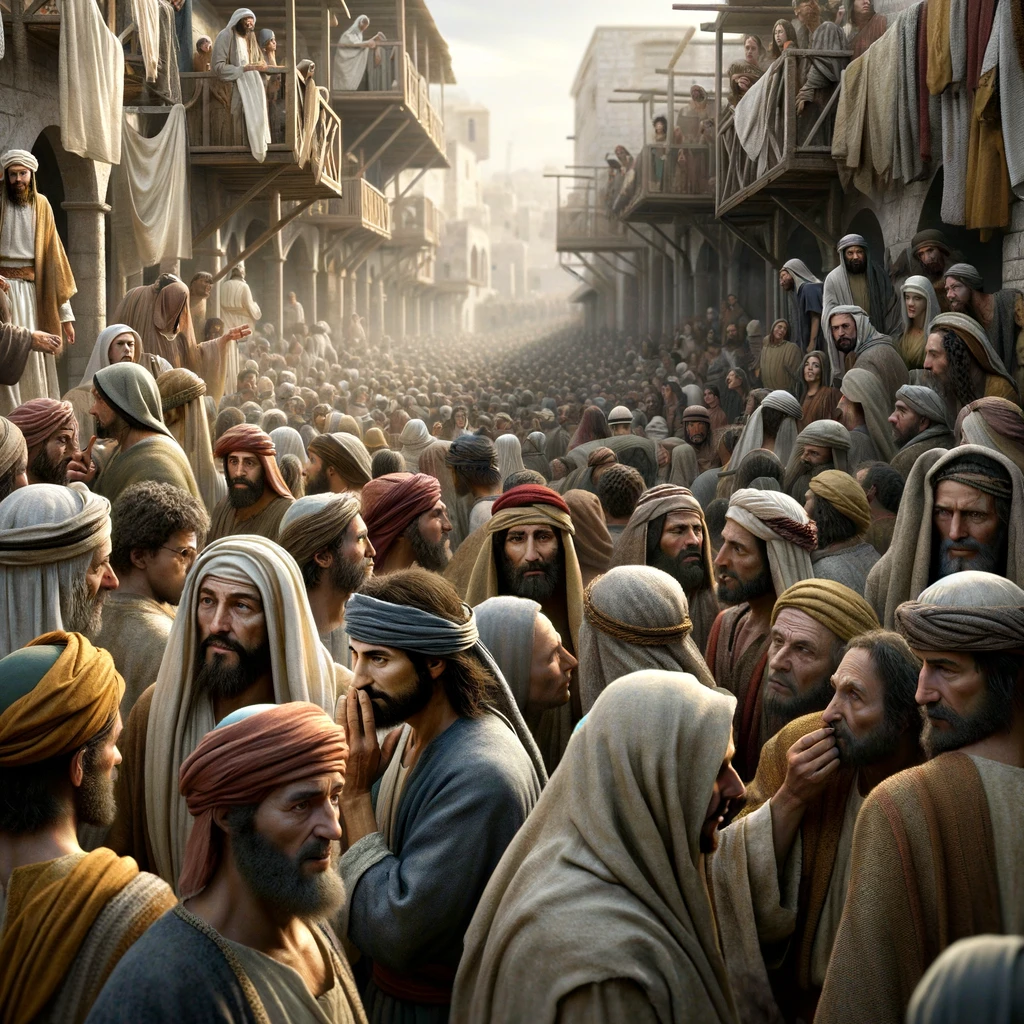
The image capturing the scene at a festival in ancient Jerusalem has been created. It depicts the atmosphere of secrecy and the diverse reactions of the people discussing Jesus, with a discrete representation of Jesus among the crowd.
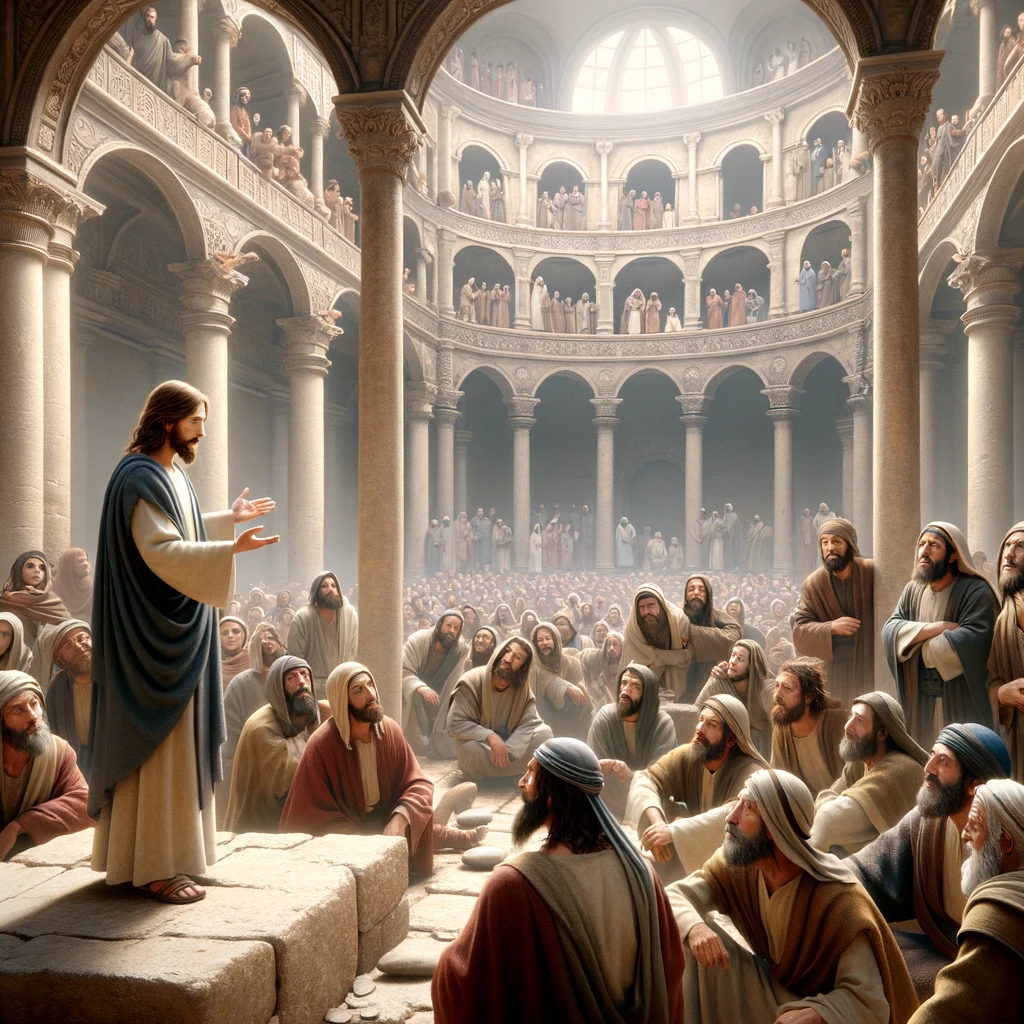
The image depicting the scene where Jesus teaches at the festival in the temple courts of ancient Jerusalem has been created. It captures Jesus engaged in teaching, surrounded by a crowd showing various reactions to his words.
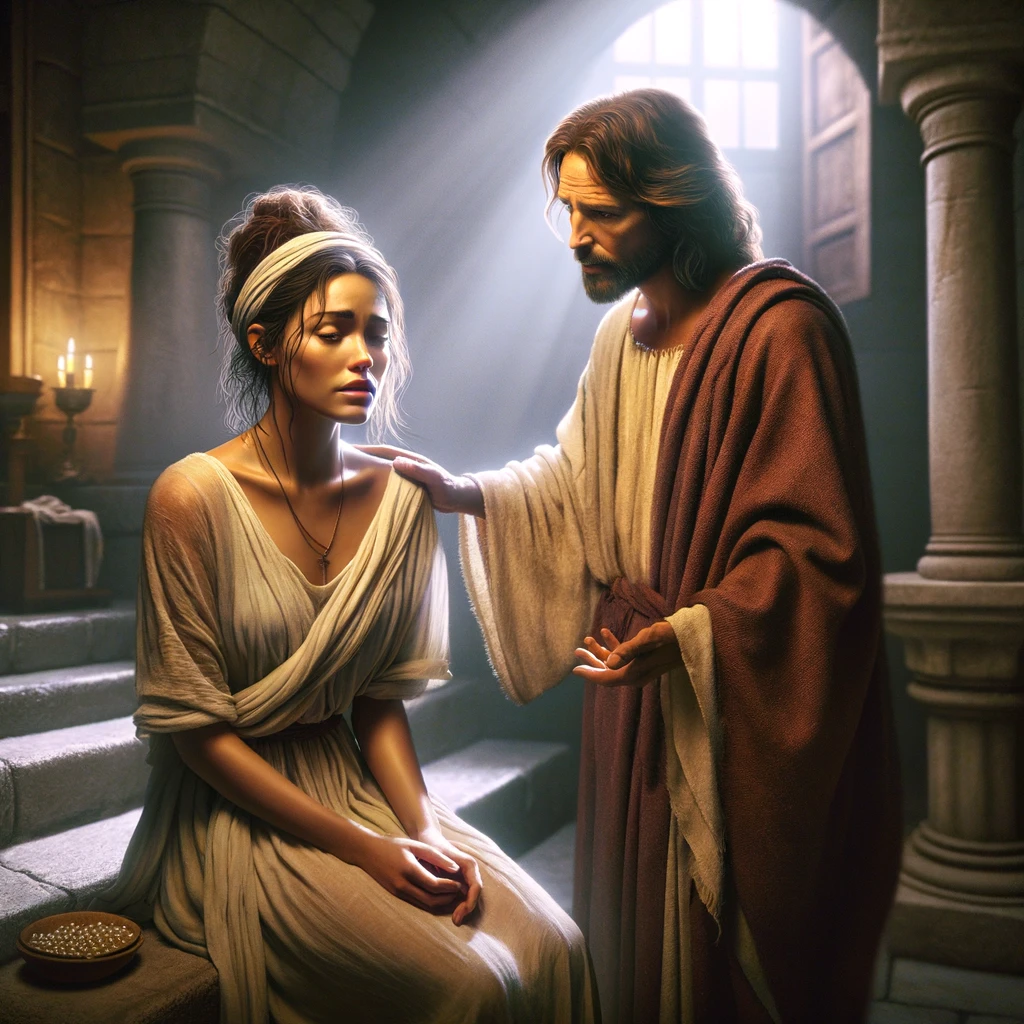
The image has been created, depicting the scene where an adulterous woman in distress is alone with Jesus in the temple, following the encounter with judgment. The portrayal emphasizes the themes of forgiveness and personal transformation in their interaction.
The image has been created, depicting the scene where Jesus proclaims himself as the light of the world, symbolizing spiritual enlightenment and understanding. The portrayal captures the essence of this profound proclamation.
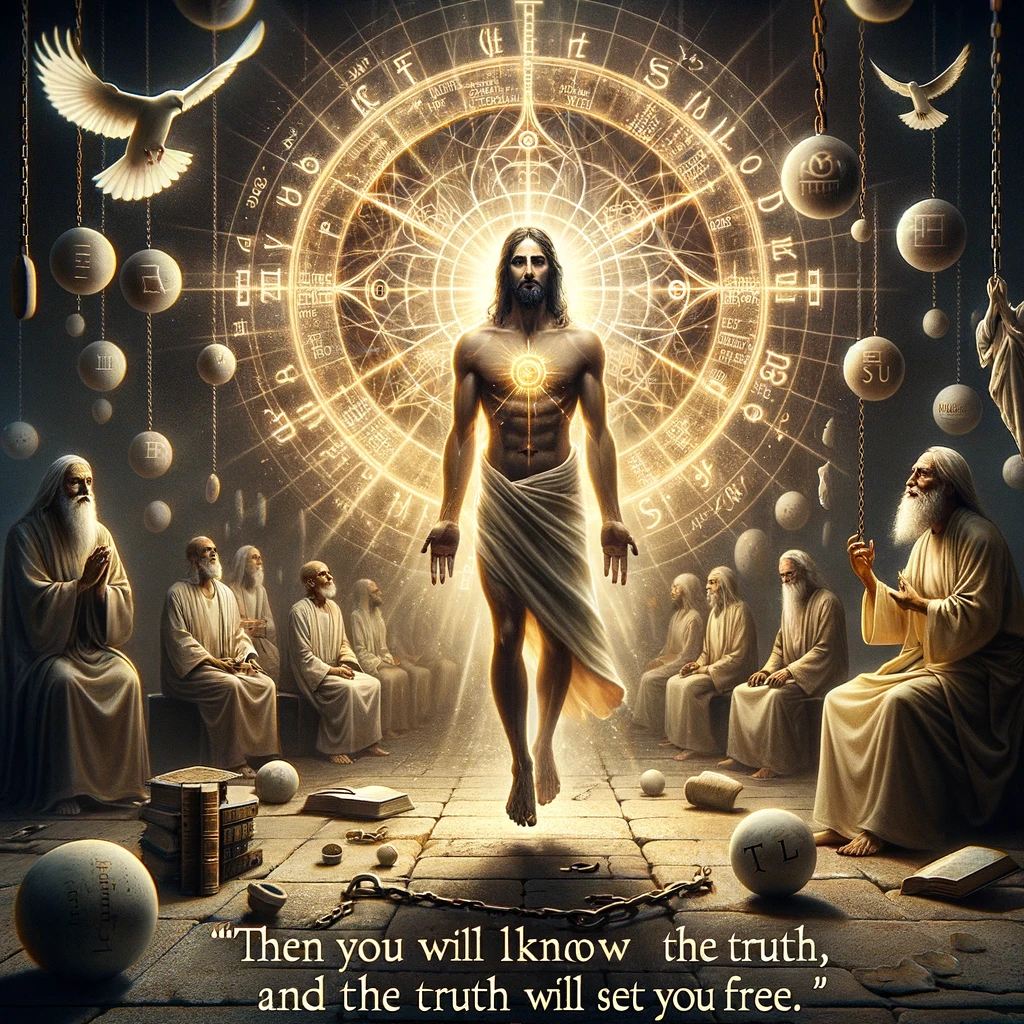
The image has been created, visually expressing the concept of “Then you will know the truth, and the truth will set you free.” It depicts the idea of true freedom as a release from inner limitations and misconceptions, with Jesus symbolizing enlightenment and spiritual liberation.

The image has been created to symbolically represent the concept of deceit and the absence of truth, as described in the biblical quote. It features abstract and metaphorical elements that convey the idea of darkness associated with lies and manipulation.
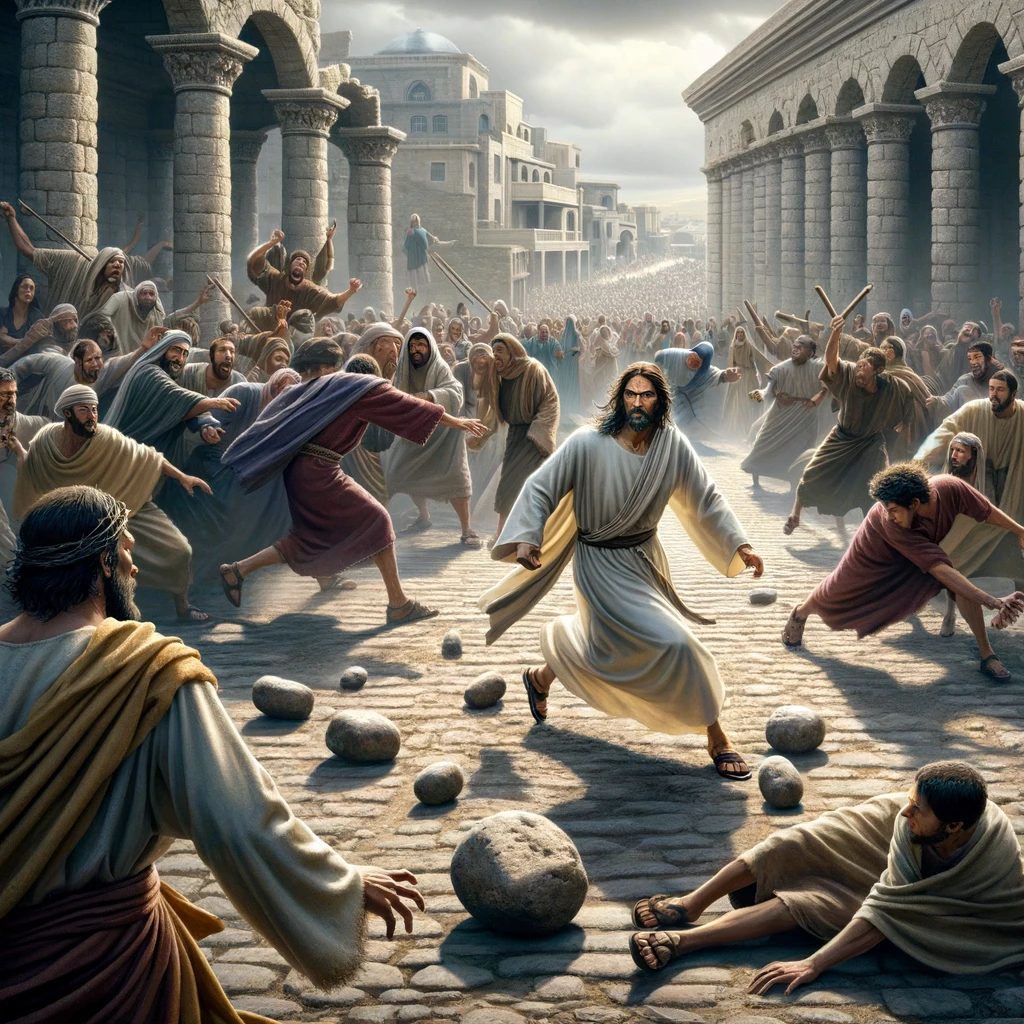
The image has been created, depicting the scene where Jesus proclaims “before Abraham was born, I am!” and then quickly evades an angry crowd in the temple grounds. It captures the moment of tension and Jesus’ discreet departure.
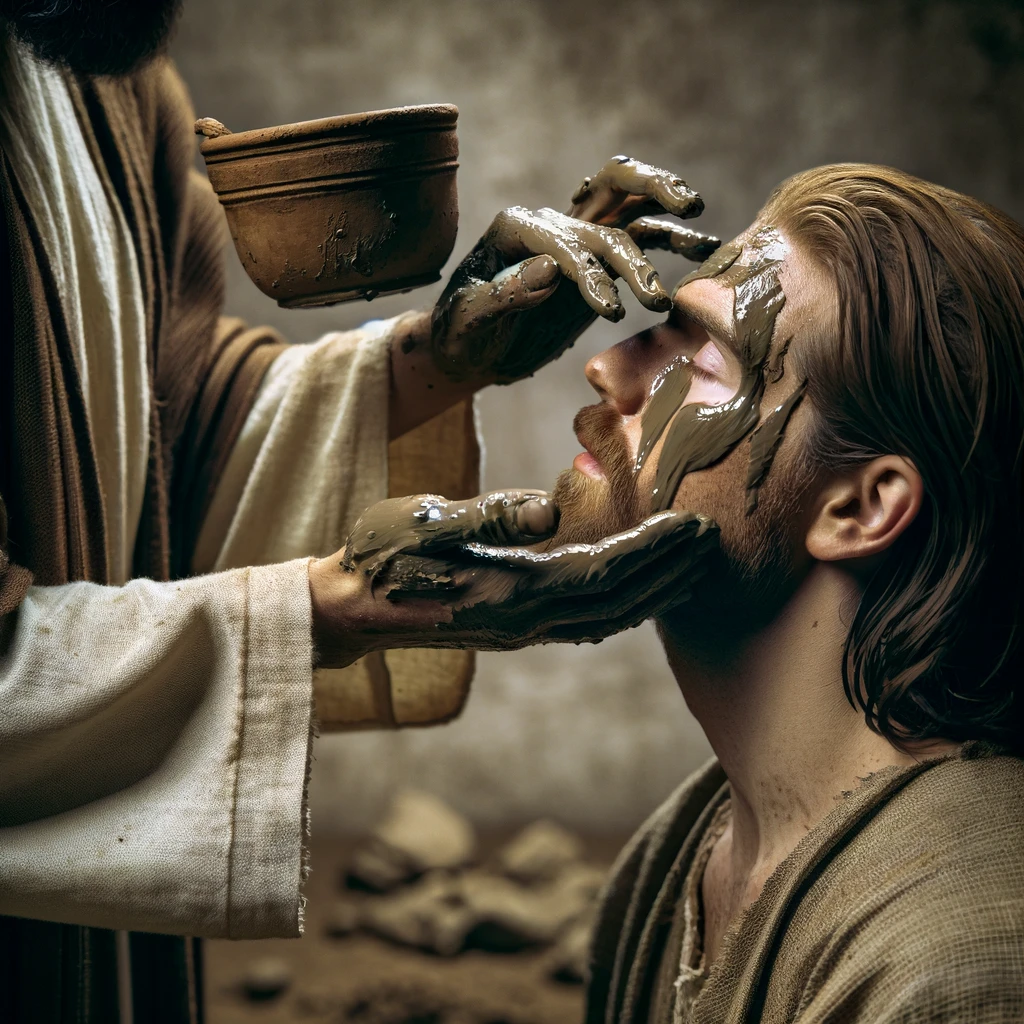

The image has been created, depicting the metaphor of the good shepherd as described by Jesus. It portrays a shepherd in a pastoral setting with his flock, symbolizing care, protection, and the bond between the shepherd and his sheep.
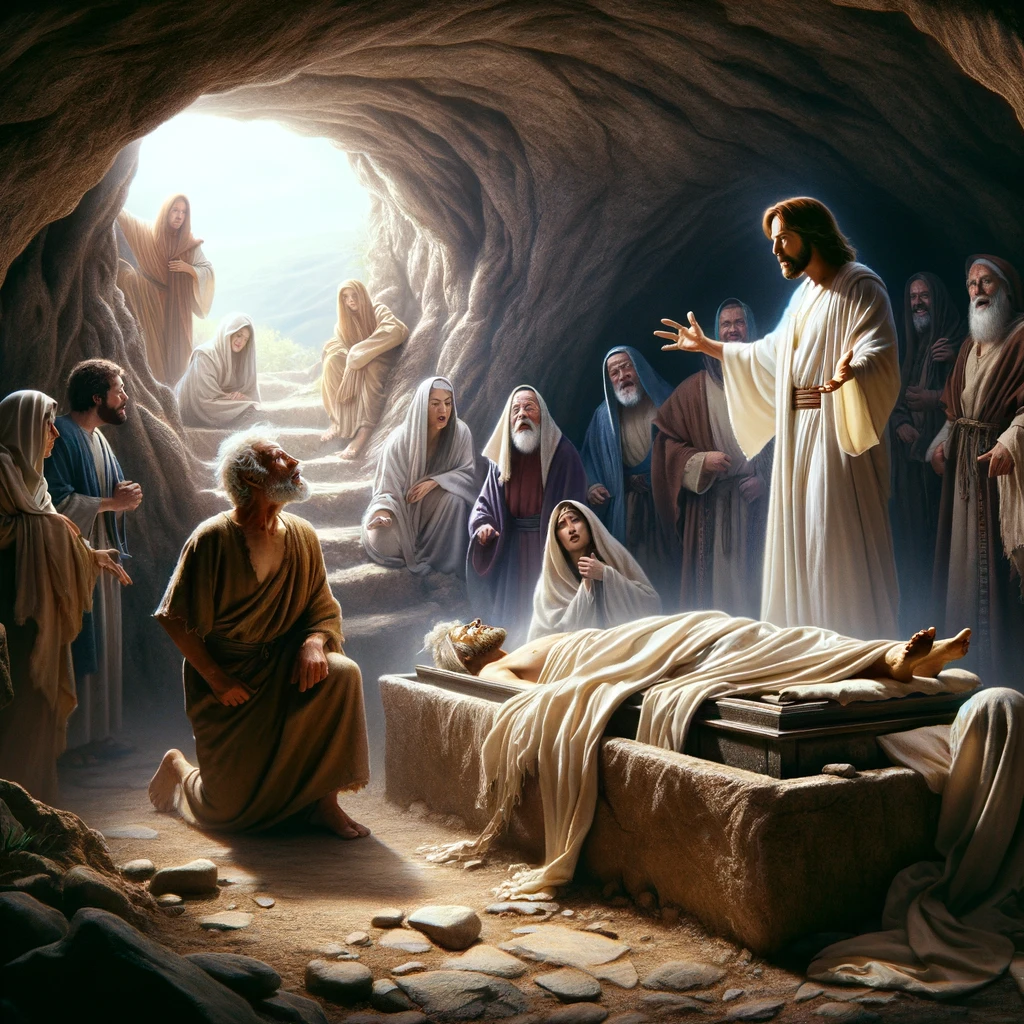
The image has been created, depicting the biblical scene where Jesus raises Lazarus from the dead. It portrays the moment Lazarus emerges from the tomb, with Jesus commanding him to come out, surrounded by onlookers in states of awe and disbelief.

The image has been created, focusing on the scene where Mary wipes Jesus’ feet with her hair, capturing the reverence and humility of this moment.

The image has been created, depicting the scene where Jesus enters Jerusalem on a young donkey, welcomed by a crowd with palm branches and shouts of “Hosanna!” It captures the jubilant and reverent atmosphere of this momentous event.
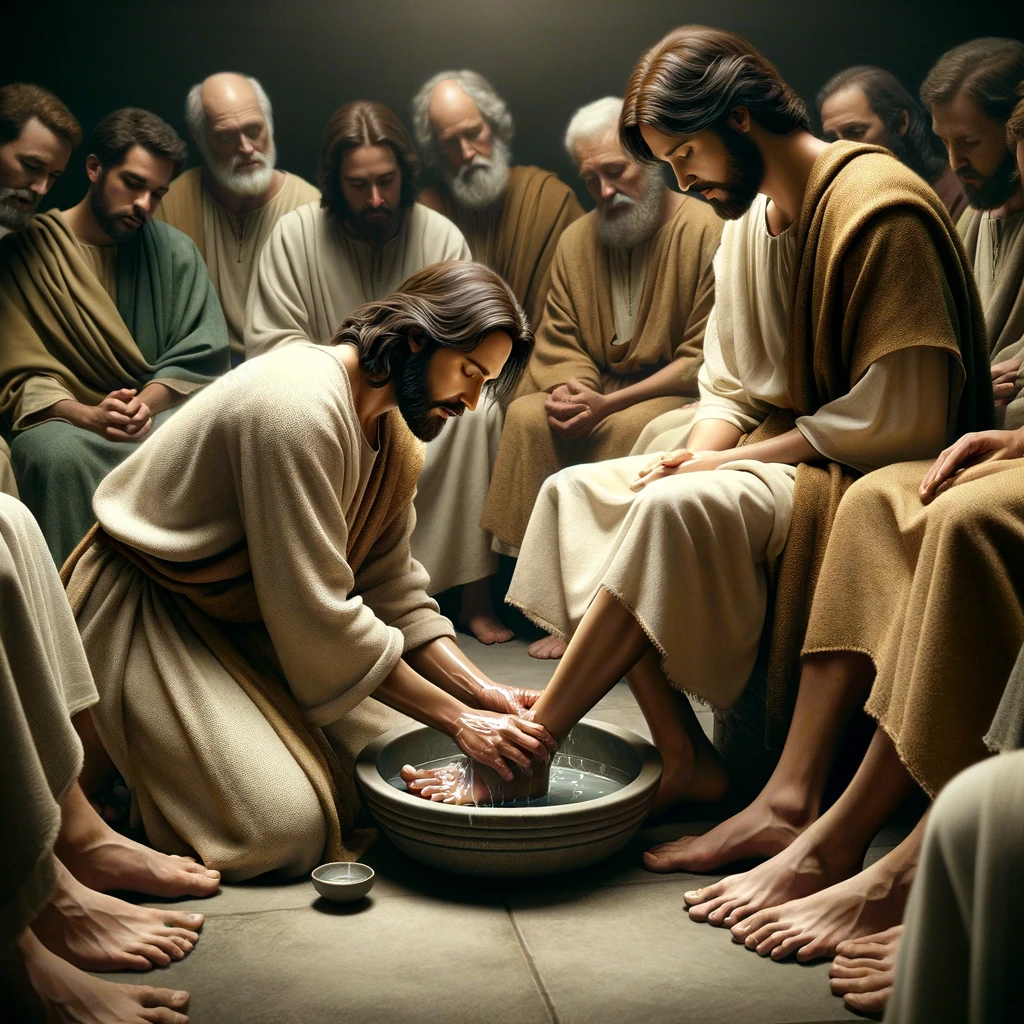
The image has been created, depicting the scene where Jesus washes the feet of a disciple, with exactly twelve disciples present in the room. The focus is on Jesus performing the act of foot washing, surrounded by the disciples in an intimate setting.

The image has been created, depicting the metaphor of the vine as introduced by Jesus. It illustrates Jesus integrated into a large, central vine, with branches extending around him to represent his followers, symbolizing the unity and interdependence of all life.
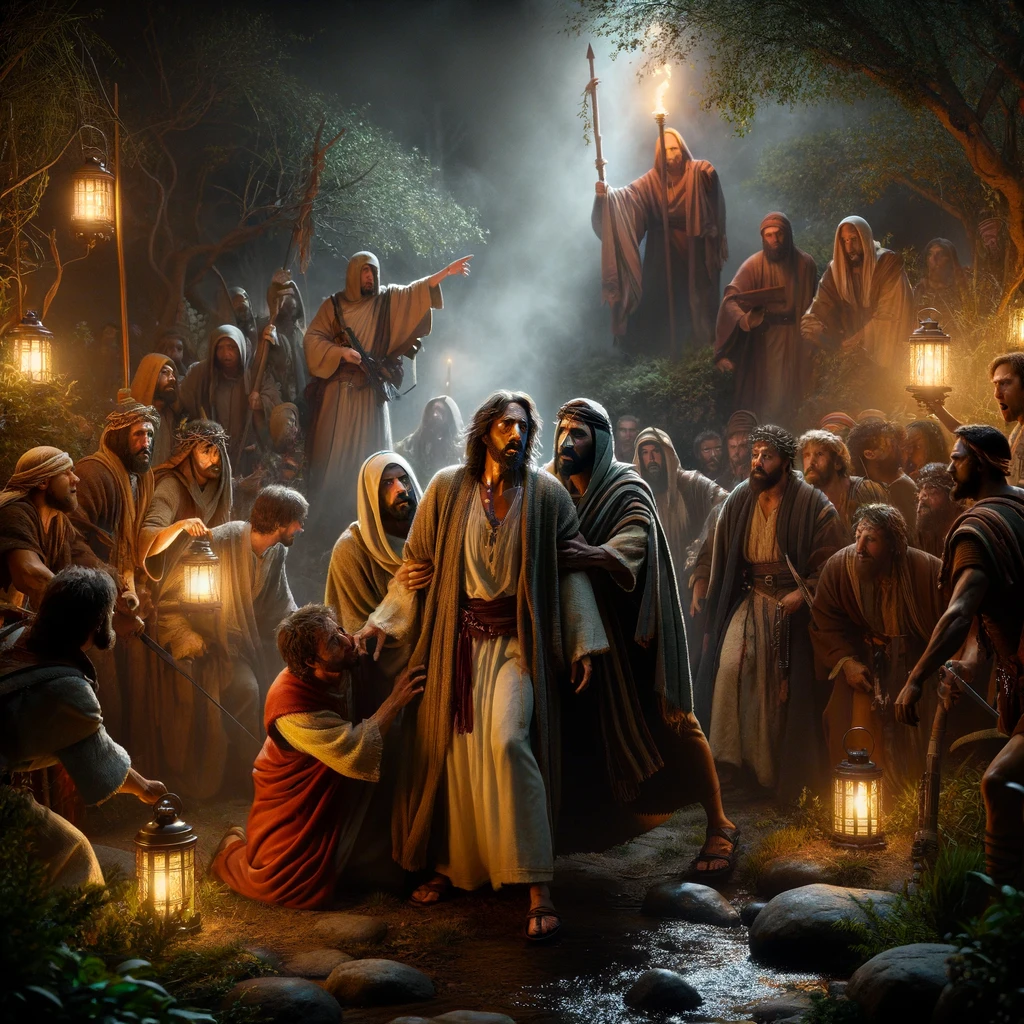
The image has been created, depicting the scene of the betrayal in a garden at night, where Jesus and his disciples are confronted by Judas leading a group with lanterns, torches, and weapons. The moment captures the tension and emotion of this significant event.


The image has been created, depicting a symbolic scene where a teacher, representing a figure of truth and love, is adorned with a crown of thorns and a purple robe. It captures the teacher’s resilience and understanding amid the symbolic representation of pain and mockery, reflecting the internal struggle and higher truths of existence.
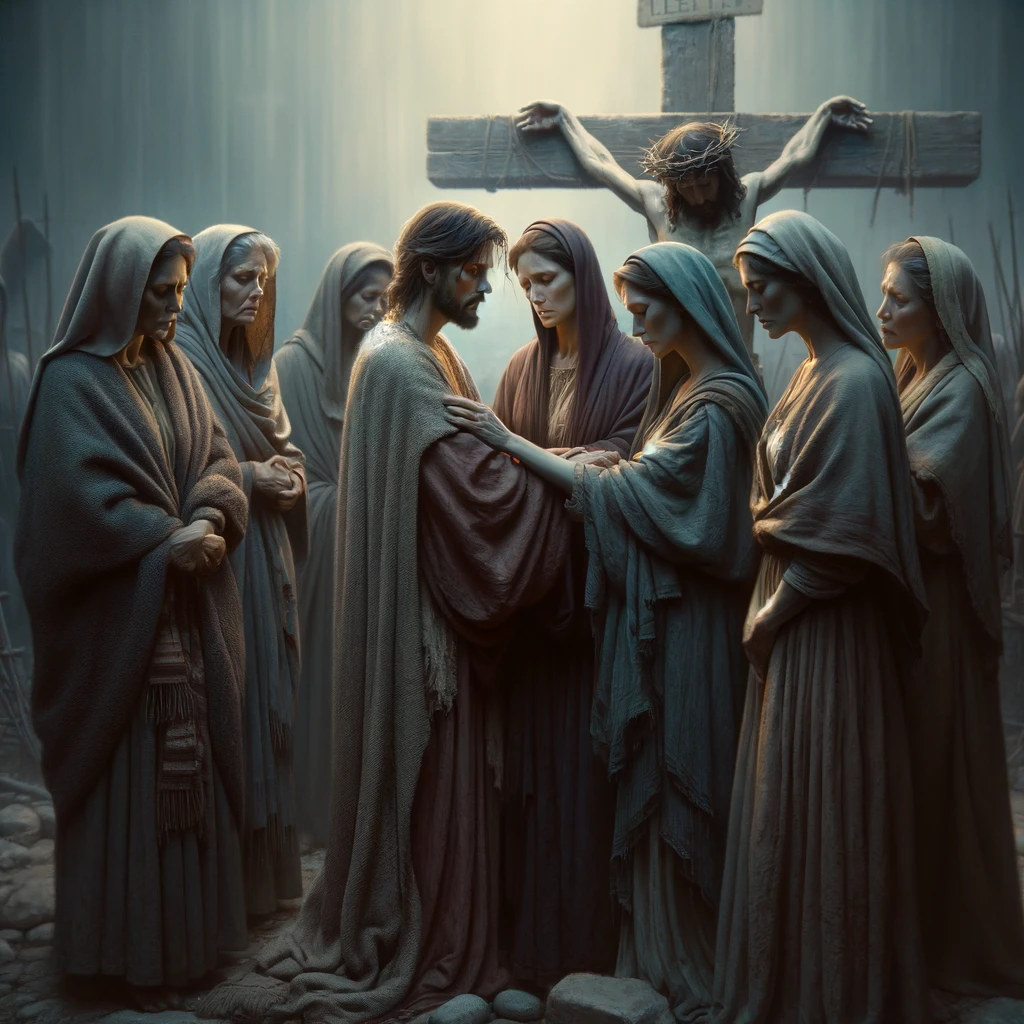
The image has been created, depicting the scene where the mother of Jesus, his mother’s sister, Mary the wife of Clopas, and Mary Magdalene stand near the cross. It captures their state of grief and solidarity, reflecting the solemnity and emotional depth of this moment.
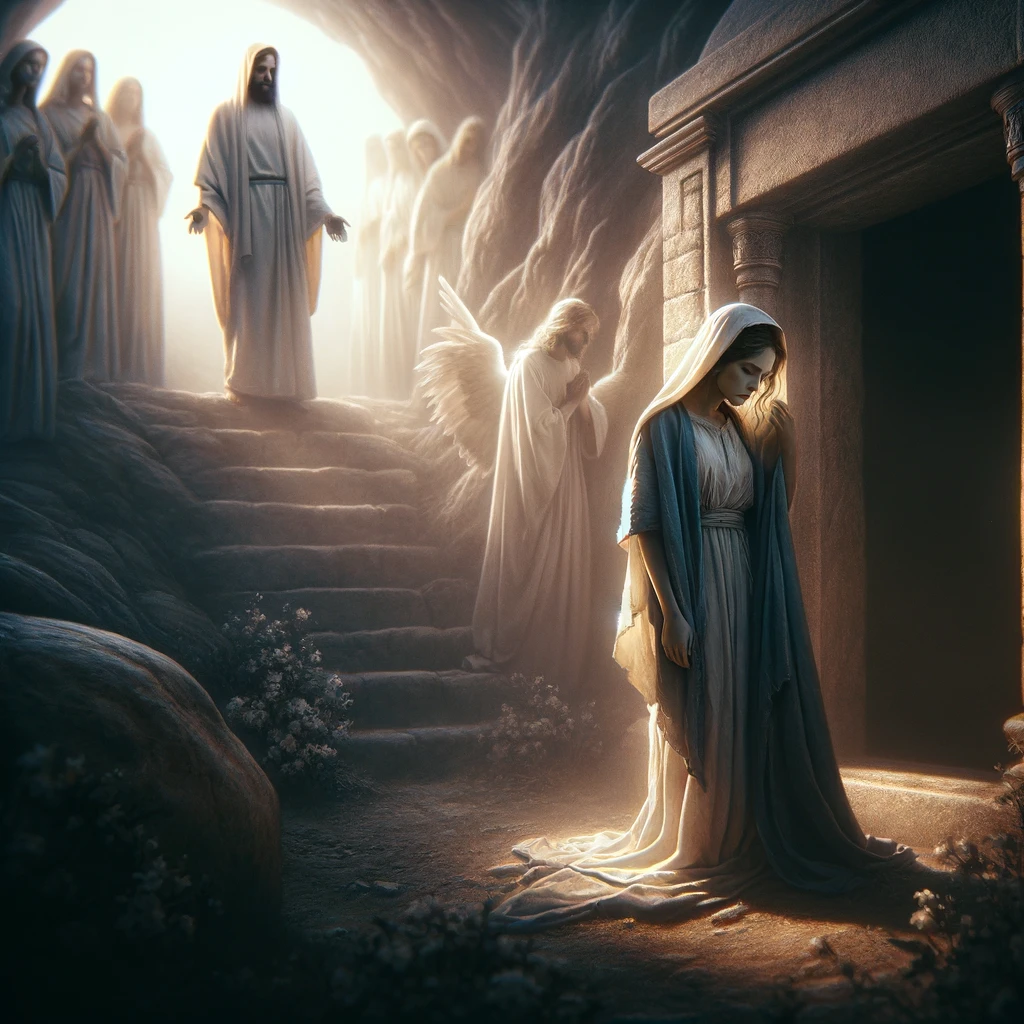
The image has been created, depicting Mary standing outside the tomb, weeping. It captures her state of sorrow and contemplation, along with the subtle presence of angels and the gradual recognition of Jesus, symbolizing the journey of the human soul towards understanding and acceptance of the divine.
 Modern Mosaic
Leave a comment