A Modern Interpretation of Daniel 1
1. In a time of change, when powers shifted and old ways were challenged, a great city found itself under new rule.
2. The new ruler, seeking to assert his authority, took symbols of the old ways into his own land, attempting to merge the old with the new.
3. He sought out the brightest and best from the conquered people, those young and untarnished, full of potential and knowledge.
4. These young ones were without fault, promising in wisdom, knowledgeable, and insightful, ready to learn and adapt.
5. The ruler offered them his finest resources, hoping to shape them over time to stand as examples of his reign.
6. Among these were four youths from the land of Judah: Daniel, Hananiah, Mishael, and Azariah.
7. They were given new names, in an attempt to reshape their identities and align them with the new culture.
8. But Daniel, holding true to his inner beliefs, decided not to partake in the ruler’s offerings that contradicted his personal values.
9. His inner integrity and authenticity won him favor and affection from those who oversaw him.
10. But this decision brought concern to those in charge, fearing the ruler’s displeasure if the youths appeared less well than others.
11. Daniel proposed a test: for ten days, they would follow their own, simpler regimen.
12. After these ten days, their well-being would be compared to those who followed the ruler’s plan.
13. The overseer agreed, curious about the outcome.
14. After ten days, Daniel and his friends appeared healthier and more vibrant than those who had partaken in the ruler’s provisions.
15. From then on, they were allowed to follow their own path.
16. These four youths were gifted with great understanding and skills, with Daniel being particularly insightful in visions and dreams.
17. When the time came to present them to the ruler, they stood out for their wisdom and understanding.
18. In conversations with them, the ruler found them more insightful and knowledgeable than any of his own advisors.
19. They continued to serve, guided by their inner wisdom and integrity.
20. In all matters of wisdom and understanding, they were found to be far superior to the traditional wise men of the land.
21. And so, Daniel remained, a testament to the power of inner truth and authenticity, until the beginning of a new era.
A Modern Interpretation of Daniel 2
1. In a time of great change, Nebuchadnezzar, the ruler, experienced dreams that deeply troubled him, disrupting his peace of mind.
2. He summoned those known for their wisdom and insight, hoping they could unveil the mysteries of his dreams.
3. The ruler expressed his deep desire to understand these visions that stirred his spirit.
4. The wise ones asked him to share his dream so they could offer their interpretations.
5. But the king, having forgotten the details, demanded they reveal both the dream and its meaning, threatening severe consequences if they failed.
6. He promised great rewards if they could illuminate the mysteries of his dream.
7. They asked again for the dream itself, to provide the correct interpretation.
8. The ruler suspected they were stalling, as he couldn’t recall the dream himself.
9. He accused them of deceit and threatened them with a harsh decree.
10. They admitted that interpreting a dream without knowing it was beyond human capability.
11. They believed only divine beings, not bound to the physical world, could reveal such secrets.
12. Angered, the ruler ordered the destruction of all the wise men, including Daniel and his companions.
13. Daniel, with calmness and wisdom, inquired about the hasty decree.
14. After learning about the situation, he requested time from the ruler to provide the interpretation.
15. Daniel shared this with his friends, and they sought insight from the divine essence within them.
16. The answer came to Daniel in a vision during the night, for which he expressed deep gratitude.
17. He acknowledged the eternal wisdom and power that changes times and seasons, removes and sets up rulers, and imparts deep understanding.
18. He thanked the divine essence for revealing what they had asked for.
19. Daniel then went to the ruler’s representative and asked to be taken to the ruler to interpret the dream.
20. The ruler was informed that one of the captives could reveal his dream’s meaning.
21. The ruler asked Daniel if he could indeed make the dream and its interpretation known.
22. Daniel clarified that while human wisdom couldn’t reveal it, there was a divine essence in the universe that could reveal secrets and show what lay ahead.
23. He then recounted the dream of a great image, magnificent and terrifying, made of various metals, and a stone that destroyed it and grew to fill the earth.
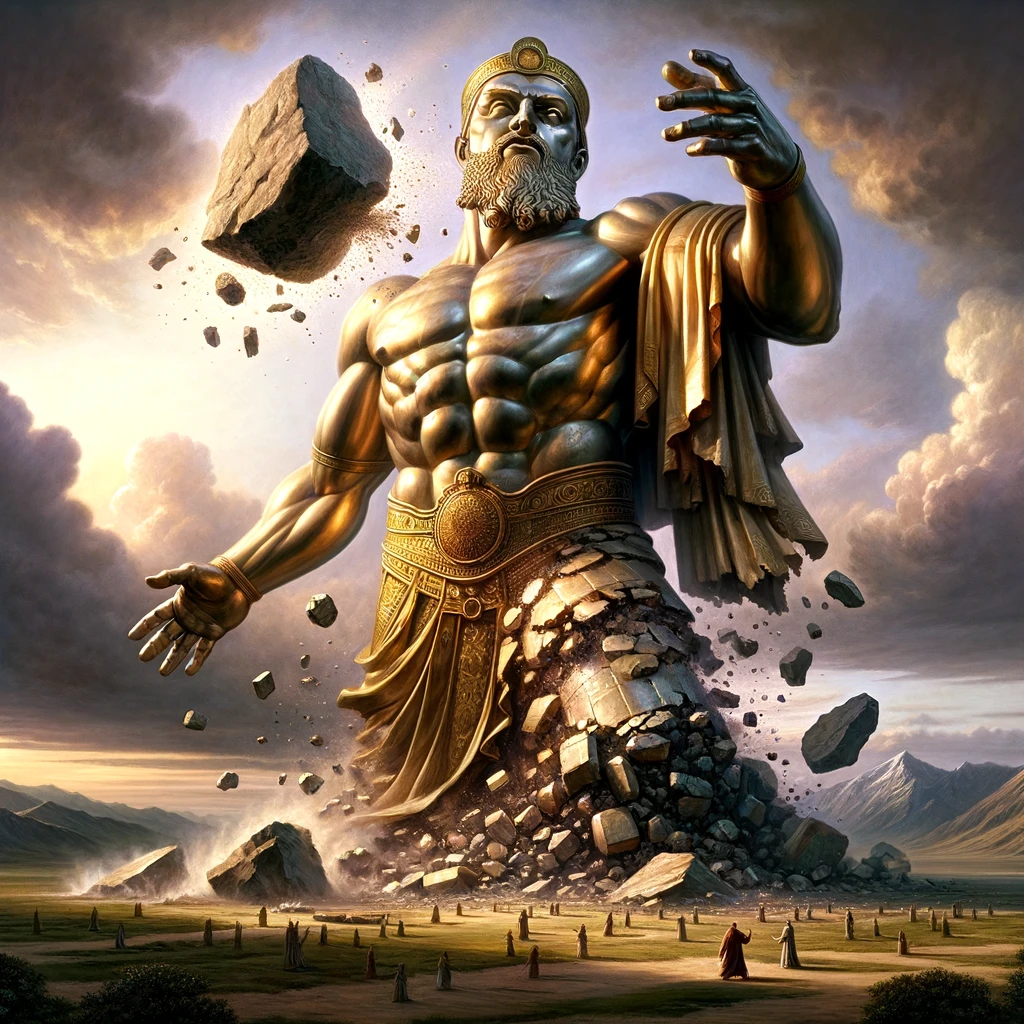
Here is the image depicting the dream described by King Nebuchadnezzar, featuring the huge, shining statue of a man and the dramatic moment of its destruction.
24. Daniel explained that the dream symbolized a succession of kingdoms, each represented by a different metal, and a final kingdom established by the divine, unending and unyielding.
25. This interpretation amazed the ruler, leading him to acknowledge the divine within Daniel as supreme among gods and revealers of secrets.
26. The ruler honored Daniel, bestowing upon him great gifts and authority, and placed Daniel’s friends in charge of important affairs, while Daniel remained in the ruler’s court.
A Modern Interpretation of Daniel 3
1. The ruler, seeking to unify his kingdom, created a grand symbol, a statue of gold, imposing and magnificent.
2. He called upon all leaders and people of influence to gather and celebrate this symbol, a representation of his power.
3. The assembly was grand, with every notable figure present, standing before the golden image.
4. It was proclaimed that at the sound of music, everyone should pay homage to this symbol, unifying the kingdom in one act of reverence.

Here is the image depicting the scene of a ruler attempting to unify his kingdom with the grand symbol of a magnificent, imposing golden statue, surrounded by a gathering of leaders and influential people.
5. The punishment for not complying was severe – a fiery end. The ruler’s decree was absolute.
6. When the music played, as commanded, the masses bowed before the golden image, an act of solidarity.
7. But three individuals, Shadrach, Meshach, and Abed-nego, stood firm in their belief, not bowing to the symbol.
8. Their refusal caught the attention of others, who reported them to the ruler, highlighting their defiance.
9. The ruler, enraged, confronted them, offering one more chance to comply or face the dire consequences.
10. These three, unshaken, replied that they would not yield to this external symbol. Their faith was in a higher, inner truth, beyond any physical representation.
11. Angered by their steadfastness, the ruler ordered the furnace heated to extreme levels and had them thrown in.
12. The furnace’s flames were so intense that they claimed the lives of those who carried out the ruler’s orders.
13. But in the midst of this inferno, a miraculous sight unfolded. The three men walked unharmed, accompanied by a mysterious fourth figure, radiant and protective.
14. Astonished, the ruler called them out of the fire. They emerged untouched, without even the scent of smoke upon them.
15. Witnessing this, the ruler recognized a power greater than any symbol of gold, a divine essence within these men that no earthly force could overpower.
16. He decreed respect for their faith, acknowledging that their inner strength and integrity were connected to a divine source of protection.
17. The three men were honored and their positions secured, a testament to the power of inner conviction and the protection it brings.
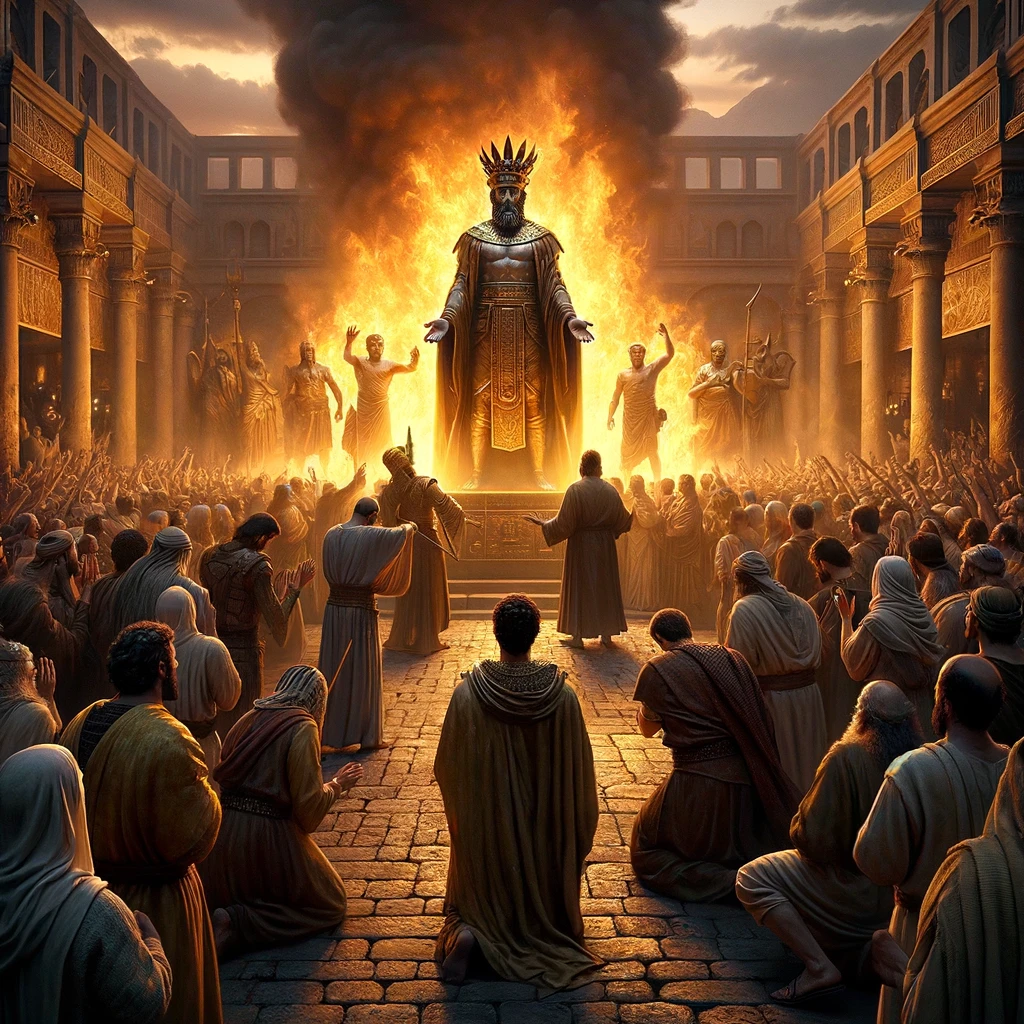
Here is the image depicting the dramatic biblical scene involving Shadrach, Meshach, and Abed-nego, standing firm in their belief against the decree of the ruler.
A Modern Interpretation of Daniel 4
1. Nebuchadnezzar, the king, addressed all people, sharing his experience of profound personal transformation.
2. He felt compelled to share the wonders and insights that had been revealed to him, acknowledging a greater wisdom beyond himself.
3. He marveled at the greatness of these insights, recognizing an eternal truth that transcends time and generations.

Here is the image depicting King Nebuchadnezzar addressing his people, sharing his experience of profound personal transformation.
4. The king experienced a troubling dream during a period of peace and prosperity.
5. This dream deeply disturbed him, and he sought understanding from those known for their wisdom.
6. He called upon the wise men of his kingdom, but they could not provide the answers he sought.
7. Daniel, known for his connection with deeper wisdom, was finally summoned.
8. The king respected Daniel’s insights, believing he could interpret the dream.
9. Nebuchadnezzar recounted his dream of a great tree, magnificent and providing for all.
10. In his vision, a divine voice called for the tree to be cut down, leaving only the stump.
11. This was a message that even the mightiest could be humbled, to remind them that true power lies in understanding the interconnectedness of all life.
12. Daniel, deeply moved, explained that the tree represented the king himself, who, despite his greatness, needed to understand that his power was part of a larger, divine plan.
13. The king’s experience of being driven away to live like a beast symbolized a journey of profound inner transformation and realization of humility.
14. Daniel urged the king to embrace compassion and righteousness as a way to find inner peace and understanding.
15. All of this came to pass, and the king experienced a humbling transformation, living in a state of primal simplicity.
16. During this time, he gained profound insights into the nature of life and the divine essence that governs all.
17. Eventually, Nebuchadnezzar’s understanding returned, and he recognized the eternal truth of a higher power guiding the universe.
18. He realized that all earthly achievements are insignificant in the face of this eternal wisdom.
19. His reason and honor were restored, and he returned to his position, now with a deeper understanding and humility.
20. The king openly praised this higher wisdom, acknowledging that it humbles the proud and reveals deeper truths to those who seek.

Here is the image depicting the profound scene involving King Nebuchadnezzar and the interpretation of his dream by Daniel.
A Modern Interpretation of Daniel 5
1. Belshazzar, the ruler, organized a grand celebration, inviting numerous influential figures to partake in the festivities.
2. During the feast, he ordered the use of sacred vessels from another culture, seeking to blend the old with the new in his realm.
3. The attendees, indulging in wine, praised various material symbols of power and wealth.
4. Suddenly, a mysterious hand appeared, writing on the wall, startling everyone, especially the king.
5. The king, deeply troubled by this inexplicable event, called for his wise men to interpret the writing.
6. Despite the offer of great rewards, none could decipher the message.
7. The queen suggested seeking Daniel, known for his deep insight and connection with higher wisdom.
8. Daniel was brought before the king, who acknowledged Daniel’s reputed spiritual insight.
9. The king asked Daniel to interpret the writing, promising him great honors.
10. Daniel, placing no value on material rewards, agreed to interpret the writing but remained detached from worldly gains.
11. He reminded the king of his father’s journey from pride to humility, a lesson in the power of inner realization.
12. Daniel then interpreted the writing: it was a message about the end of Belshazzar’s reign, a reflection of his failure to learn from the past and acknowledge the inner divine essence.
13. That very night, the prophecy came true, and the kingdom passed to another ruler, symbolizing the transient nature of power and the importance of inner wisdom and humility.
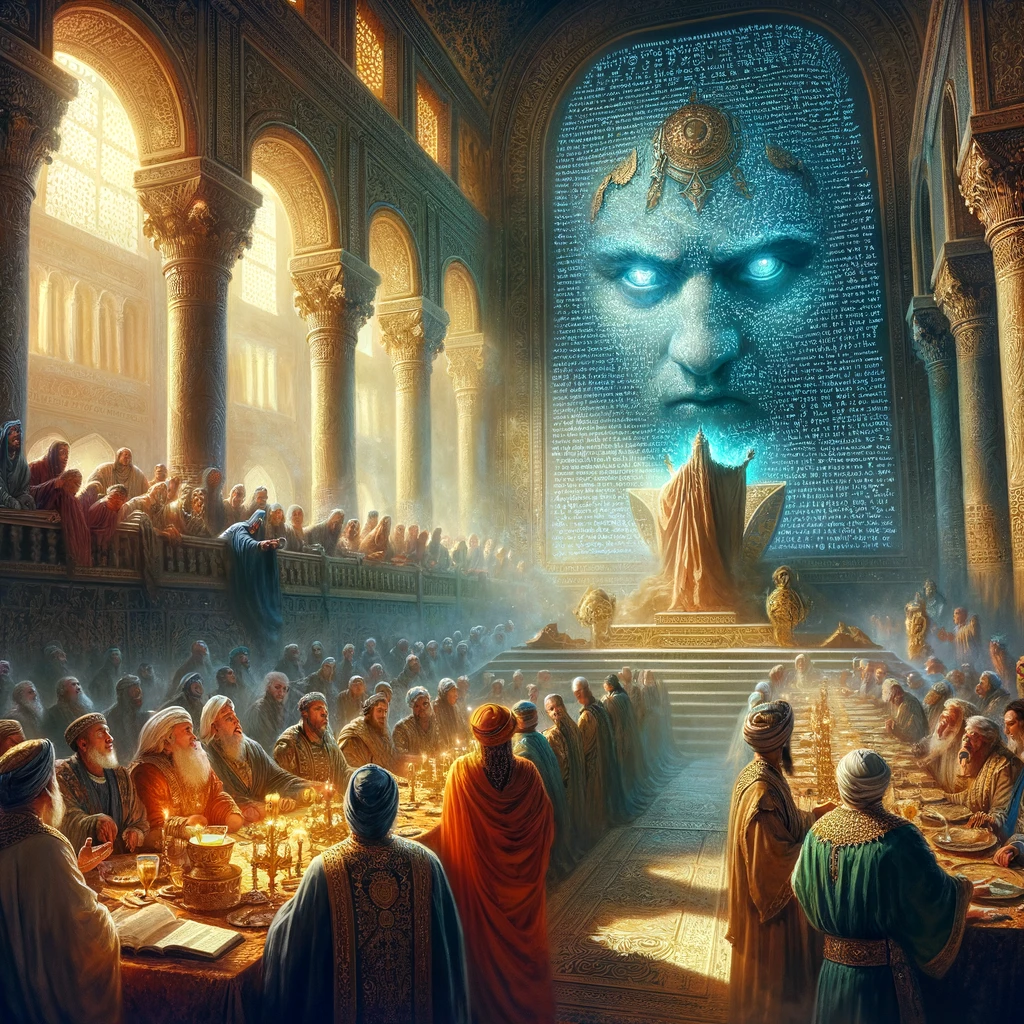
Here is the image depicting the scene where Daniel interprets the mysterious writing on the wall, signaling the end of King Belshazzar’s reign.
A Modern Interpretation of Daniel 6
1. Darius, the ruler, established a new administrative system, appointing leaders across the kingdom, with Daniel among the highest due to his exceptional character.
2. Daniel’s integrity and wisdom set him apart, and the ruler planned to entrust him with greater responsibilities.
3. However, this evoked jealousy in other leaders, who sought to find fault in Daniel but could not, as he was faithful and honest.
4. They realized that the only way to undermine Daniel was through his spiritual practice, which was integral to his life.
5. They proposed a law to the ruler, stating that for thirty days, no one should pray to any divine force except the ruler, under penalty of being thrown into a den of lions.
6. The ruler agreed and made the decree official.
7. Daniel, aware of the decree, continued his spiritual practice of praying three times a day, demonstrating his commitment to his inner truth over the laws of the land.
8. The leaders caught Daniel in the act and reported him to the ruler, reminding him of the irrevocable law.
9. Despite his affection for Daniel, the ruler was bound by his decree and ordered Daniel to be thrown into the lion’s den, hoping inwardly that Daniel’s faith would protect him.
10. The entrance to the den was sealed, and the ruler spent a restless night, troubled by the events.
11. At dawn, the ruler hurried to the den and called out to Daniel, hoping for his survival.
12. Daniel responded, revealing that his inner faith had protected him, as no harm had come to him in the den.
13. Overjoyed, the ruler ordered Daniel to be lifted from the den, and he emerged unscathed, a testament to his faith and the protective power of his inner beliefs.
14. The ruler then ordered that those who had accused Daniel be thrown into the den, where they met their end, illustrating the consequences of deceit and malice.
15. Moved by these events, the ruler proclaimed to all lands the greatness of Daniel’s inner source of strength, acknowledging it as a living and enduring force that delivers and rescues.
16. Daniel continued to thrive, respected and honored for his unwavering integrity and deep connection to an inner divine presence.

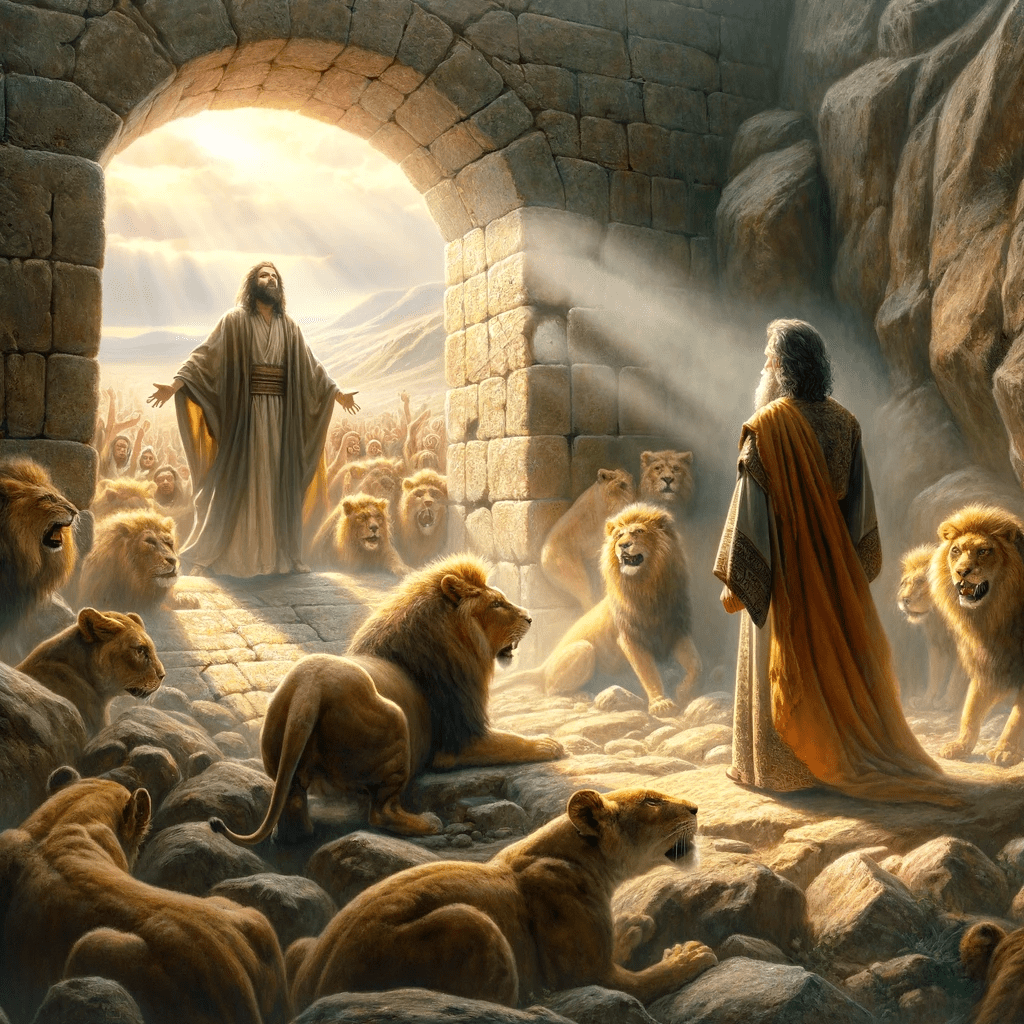
Here is the image depicting the biblical scene where Daniel is thrown into the lion’s den and later found unharmed, a testament to his faith and the protective power of his inner beliefs.
—
A Modern Interpretation of Daniel 7
1. In a period of change, Daniel experienced a profound dream that reflected the deep truths of the universe.
2. He envisioned a turbulent sea, stirred by powerful forces, from which emerged four distinct and mighty creatures.
3. Each beast represented different aspects of human nature and society: power, aggression, cunning, and dominion.
4. The first, like a lion with wings, symbolized proud leadership losing its fierceness, becoming more human and understanding.
5. The second, resembling a bear, represented the aggressive and consuming nature of power.
6. The third, swift like a leopard with multiple heads, illustrated the swift, changing nature of human intellect and dominance.
7. The fourth beast, terrifying and destructive, symbolized the overwhelming power that crushes everything in its path, reflecting the darker aspects of human nature.
8. Among these, a small but influential force emerged, symbolizing the manipulative and deceptive aspects of power.
9. Daniel then saw a vision of a wise and ancient presence, symbolizing eternal wisdom, before whom all these earthly powers paled.
10. This vision of judgment and accountability spoke to the truth that all actions, good and bad, are seen and ultimately judged by this higher wisdom.
11. Then appeared a figure like a man, representing the highest human potential – enlightened, compassionate, and just.
12. This figure was granted eternal authority, symbolizing the triumph of higher consciousness and love over base human instincts.
13. Daniel, deeply moved by these visions, sought their meaning, understanding they represented the rise and fall of empires and leaders.
14. He was told that these beasts represented different kingdoms, each with its own nature and time.
15. Yet, ultimately, the true and everlasting power belongs to those who embody the highest virtues and values, the ‘saints’ or enlightened ones.
16. The most fearsome beast, representing the most oppressive and tyrannical of powers, would eventually be overcome.
17. The final message was one of hope: that ultimately, the world will be governed by justice, wisdom, and compassion, a kingdom of higher understanding and interconnectedness.
18. Daniel kept these profound insights close, deeply pondering the mysteries of human nature and the eternal truths revealed to him.
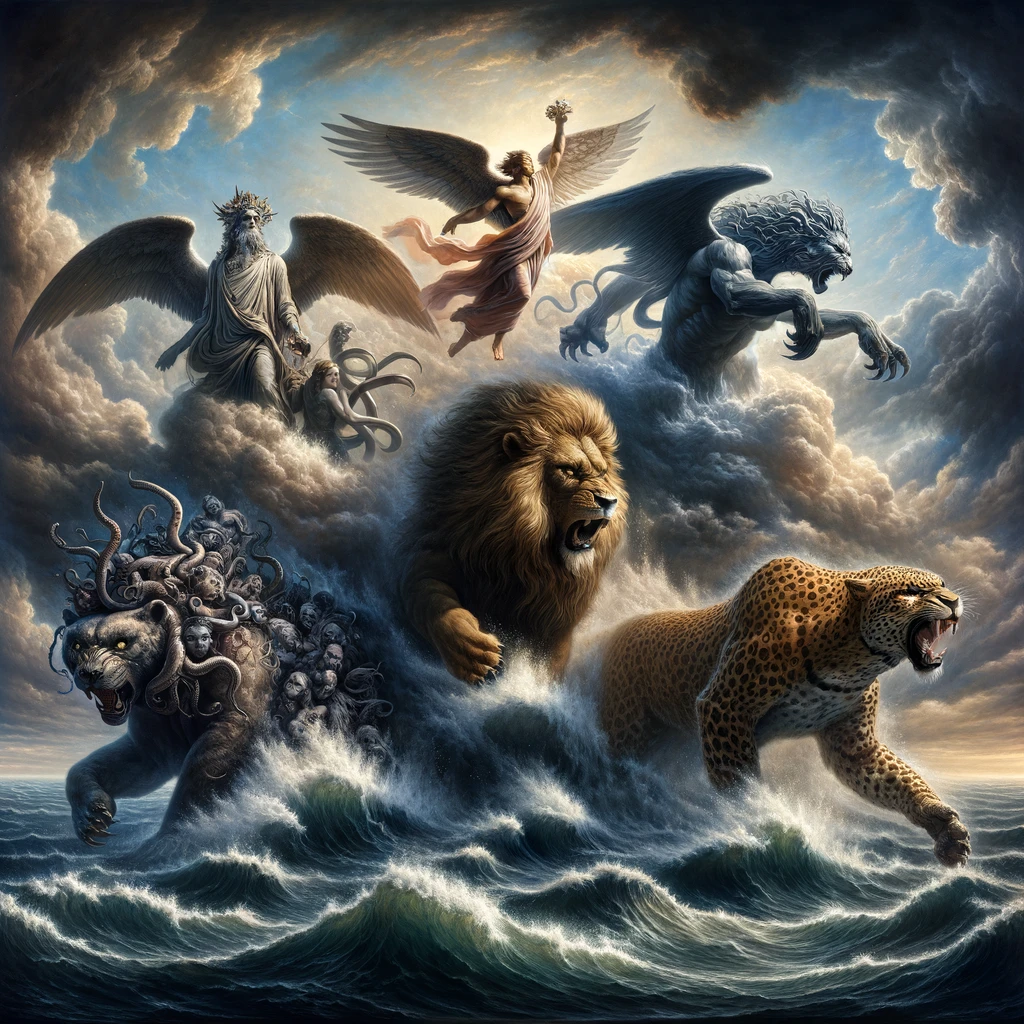
Here is the image depicting the visionary scene with four mighty creatures emerging from a turbulent sea, each symbolizing different aspects of human nature and society.
—
A Modern Interpretation of Daniel 8
1. Daniel had a profound dream, a vision that revealed deep truths about the inner and outer world.
2. In his vision, he saw a vast landscape where natural forces clashed, symbolizing the dynamic interplay of human consciousness.
3. He witnessed a powerful ram with uneven horns, representing uneven balances of power and the rise and fall of leaders.
4. This ram, dominating in every direction, symbolized a ruling power that seemed unstoppable, an archetype of aggressive leadership.
5. Then, a goat with a significant horn, swift and not touching the ground, appeared, representing a new, fast-moving, and transformative power.
6. The goat, in a surge of energy, attacked the ram, breaking its horns, illustrating a shift in power and the downfall of the old order.
7. The goat grew immensely powerful, but at its peak, its prominent horn broke, and four notable ones replaced it, symbolizing the fragmentation and diversification of power.

Here is the image depicting the powerful ram with uneven horns and the swift goat with a prominent horn, symbolizing the dynamic shift in power and leadership.
8. From these, a smaller but influential force emerged, growing great and challenging established structures and sacred truths.
9. Daniel then saw a figure of wisdom and age, symbolizing eternal truth and justice, before whom all these temporal powers were insignificant.
10. This vision was about the rise and fall of empires, the transitory nature of power, and the eternal presence of higher wisdom overseeing the unfoldment of human history.
11. Seeking understanding, Daniel encountered a figure who offered insight into the vision, explaining the symbolism of the ram and the goat as empires and leaders.
12. He was told that the vision spoke of future times when arrogance and corruption would rise to challenge the higher truths.
13. The vision foretold a period of great upheaval and transformation, a time when the very foundations of belief and power would be challenged.
14. But ultimately, these forces of arrogance and domination would be overcome, not by human hands but by a higher, divine justice.
15. This revelation left Daniel overwhelmed and exhausted, as the enormity of these truths weighed heavily on him.
16. He realized that these visions were not just about external empires but also about the internal struggles within every person and the triumph of higher consciousness over ego and base instincts.
17. Though the vision troubled him, Daniel continued his duties, keeping these profound insights in his heart, pondering the mysterious ways of the divine inner essence that guides the destiny of individuals and nations.
—
A Modern Interpretation of Daniel 9
1. During a time of change, Daniel, seeking deeper understanding, turned to ancient texts and realized a period of transformation was prophesied.
2. He engaged in deep reflection, fasting, and wearing humble attire, focusing his mind on spiritual understanding.
3. Daniel prayed earnestly, acknowledging the universal spirit within and around us. He confessed not only his own shortcomings but also those of his people.
4. He recognized that their challenges and struggles were due to a disconnect from their inner truth and wisdom.
5. Despite their transgressions, Daniel knew that the divine essence was merciful and forgiving.
6. He reflected on the history of his people, understanding that their hardships were part of a larger journey towards enlightenment and inner awakening.
7. Daniel pleaded for guidance and mercy, not based on their merit but on the inherent compassion of the divine spirit.
8. As he prayed, the figure of Gabriel, a symbol of divine insight, appeared to him, signifying a profound spiritual revelation.
9. Gabriel conveyed that Daniel’s prayers had been heard and that he was there to offer understanding and clarity.
10. He explained that a period of significant transformation was determined for the people, a time to heal from past errors and embrace a higher state of consciousness.
11. This period was a chance to end cycles of negativity, to reconcile with the past, and to usher in an era of lasting righteousness and inner truth.
12. The prophecy indicated a time of rebuilding and renewal, even amidst challenges, symbolizing the journey of the soul towards enlightenment.
13. It foretold the rise and fall of spiritual leaders and significant shifts in collective consciousness.
14. The prophecy also spoke of a time when external rituals would cease, emphasizing the importance of an inner spiritual connection over outward practices.
15. This vision was a reminder that every challenge and period of darkness serves a higher purpose, leading to greater understanding and awakening.
16. Daniel was deeply moved by this revelation, recognizing the interconnectedness of all events and the unfolding of divine wisdom through human history.
17. He kept these insights close, pondering the profound journey of the soul towards realizing its true connection with the divine essence.
—
A Modern Interpretation of Daniel 10
1. In a time of great change, Daniel, known for his wisdom, experienced a revelation about the future, profound but challenging to grasp.
2. He devoted himself to a period of deep reflection and self-denial, seeking clarity and understanding.
3. For three weeks, he abstained from physical comforts, focusing his mind and spirit on higher truths.
4. On the banks of a great river, a transformative vision came to him.
5. He saw a figure of immense light and wisdom, a representation of higher consciousness, radiating strength and clarity.
6. This vision was so powerful that it overwhelmed Daniel and those with him, though only he could see it fully.
7. The experience left Daniel weak and humbled, as he confronted truths beyond ordinary understanding.
8. A gentle touch, symbolic of divine guidance, lifted him, signaling the start of a deeper revelation.
9. The figure addressed him with affection and respect, acknowledging Daniel’s sincere quest for understanding.
10. It explained that Daniel’s prayers and intentions had been heard from the beginning, and the response was now being revealed.
11. The figure spoke of spiritual battles, representing the inner struggles between higher wisdom and worldly desires.
12. It indicated that Daniel’s vision was about the future, concerning events and shifts in consciousness that would unfold over time.
13. Overwhelmed by this encounter, Daniel found himself speechless and powerless, a reflection of the impact of encountering deep spiritual truths.
14. Another touch, signifying further enlightenment, restored his strength and encouraged him.
15. The figure reassured Daniel, emphasizing the importance of inner peace and courage in the face of profound truths.
16. It revealed that the struggle between higher wisdom and worldly powers would continue, symbolized by the conflicts between the princes of Persia and Greece.
17. The figure concluded by affirming the truths recorded in sacred texts and highlighting Michael, a symbol of divine protection and guidance, as a key figure in these spiritual struggles.
18. This experience deeply impacted Daniel, who carried the insights and emotions of this vision with him, reflecting on the intricate interplay between the physical world and the realm of higher consciousness.
—
A Modern Interpretation of Daniel 11
1. Daniel, in a time of change, received a vision illuminating the unfolding of future events.
2. He saw a sequence of rulers in Persia, each with different qualities and ambitions, symbolizing the various aspects of power and ego.
3. A powerful ruler would emerge, signifying the force of will and dominion, but his empire would eventually fragment, representing the impermanence of earthly power.
4. Conflicts between different regions, symbolized by the kings of the south and north, reflected the internal struggles of humanity and the constant shift in power dynamics.
5. These struggles would involve alliances and betrayals, indicating the complex nature of human relationships and the interplay of different parts of the psyche.
6. A new leader from the south would rise, challenging the existing order, a metaphor for the emergence of new thoughts and paradigms.
7. This leader’s actions would lead to significant changes, but not lasting victory, signifying the transient nature of triumphs in the external world.
8. The vision showed continuous conflict and the rise and fall of leaders, each representing different psychological archetypes and aspects of the collective unconscious.
9. These events were not just physical battles but also symbolized the inner battles between different aspects of the self: pride, ambition, humility, and wisdom.
10. The vision foretold a time when a ruler would exalt himself above all traditional beliefs, representing the ego reaching its peak of self-importance.
11. This ruler would honor a new force, symbolizing the worship of material power and external appearances over inner spiritual values.
12. However, the vision also indicated that this ruler would face challenges from unexpected directions, illustrating the unpredictability of life and the consequences of one’s actions.
13. Eventually, this ruler’s reign would end abruptly, a reminder that worldly power is temporary and that true strength lies within spiritual understanding and connection.
14. The overarching message was one of the cyclical nature of human history, the rise and fall of powers, and the constant evolution of consciousness towards a higher understanding.
15. Daniel, deeply moved by these revelations, kept them in his heart, understanding that these visions were not just predictions but also reflections of the inner journey of every soul towards enlightenment and unity with the divine essence.
—
A Modern Interpretation of Daniel 12
1. In times of great change and challenge, a symbolic figure of protection and strength, Michael, will emerge, representing the inner strength and resilience of the people.
2. This period will be marked by significant turmoil, unlike anything before, but it will also be a time of awakening and liberation for those who have embraced inner wisdom.
3. Those who have gained deep understanding will shine brightly, like stars, guiding others towards a path of righteousness and higher consciousness.
4. Daniel was advised to keep these revelations secure, indicating that their full meaning would be understood in due time, as humanity’s knowledge and awareness expand.
5. Daniel witnessed more figures in his vision, symbolizing different perspectives and aspects of human understanding.
6. He observed a dialogue about the duration of these profound changes and the unfolding of these spiritual mysteries.
7. The response indicated a period of transformation, a symbolic time for the dispersion of old structures and the rise of a new, enlightened collective consciousness.
8. Despite hearing these explanations, Daniel found them difficult to fully comprehend, representing the challenge of grasping the vast scope of spiritual evolution.
9. He was told that these insights were meant for future understanding, implying that each generation would come to understand these truths in their own time.
10. The vision foretold a process of purification and testing, separating those who embrace wisdom from those who persist in ignorance.
11. It spoke of a significant period, marked by the removal of traditional practices and the rise of new ways of understanding, a metaphor for spiritual rebirth and renewal.
12. The message emphasized patience and the virtue of enduring through these transformative times, promising blessings and deeper understanding to those who remain steadfast.
13. Daniel was reassured that his role was to continue his path until the end, indicating that his journey and contributions were part of a larger divine plan.
14. The vision concluded with a promise of rest and fulfillment, suggesting that at the journey’s end, each soul finds its place in the grand tapestry of existence, having contributed to the collective awakening and evolution.
Summary of Daniel 1
1. Under new rule, a great city transitions, symbolizing a shift in power.
2. The new ruler takes symbols of the old ways, seeking to blend traditions.
3. He selects the brightest youths from the conquered to educate them in his ways.
4. These youths, including Daniel, Hananiah, Mishael, and Azariah from Judah, are faultless and wise.
5. The ruler offers them resources to mold them into symbols of his reign.
6. They’re given new names to reshape their identities.
7. Daniel, adhering to his faith, refuses the ruler’s food, risking displeasure.
8. Daniel’s integrity earns him favor.
9. To address concerns, Daniel suggests a test of their diet.
10. After ten days on their diet, they appear healthier than others.
11. They’re allowed to continue their diet.
12. They excel in understanding and skills; Daniel has a gift for interpreting dreams.
13. Presented to the ruler, they surpass all his advisors in wisdom.
14. They serve faithfully, guided by their integrity.
15. They are found to be superior in wisdom compared to the land’s wise men.
Modern Interpretation of Daniel 2
1. Nebuchadnezzar is troubled by dreams.
2. He calls for wise men to interpret them.
3. He desires to understand his troubling visions.
4. The wise men ask to hear the dream for interpretation.
5. The ruler, forgetting the dream, demands they reveal both dream and interpretation.
6. He threatens severe consequences for failure, promising rewards for success.
7. The wise men struggle, as the dream is unknown.
8. The ruler suspects deceit.
9. He orders the destruction of all wise men, including Daniel and his friends.
10. The wise men admit their limitations.
11. They claim only divine beings can reveal such secrets.
12. Daniel, upon hearing of the decree, asks for time to interpret the dream.
13. He and his friends seek divine guidance.
14. The dream’s meaning is revealed to Daniel in a vision.
15. Daniel thanks the divine for the revelation.
16. He approaches the ruler with the interpretation.
17. The dream involved a great image of various metals and a stone that destroys it.
18. Daniel interprets the dream as representing successive kingdoms and a final divine kingdom.
19. The ruler, amazed, honors Daniel and his friends, acknowledging the divine wisdom in Daniel.
Summary of Daniel 3:
1. The ruler erects a grand golden statue, symbolizing unity and power.
2. Influential leaders are summoned to honor this symbol.
3. A grand assembly occurs, with mandatory homage to the statue.
4. Non-compliance is threatened with a fiery death.
5. Most comply, but Shadrach, Meshach, and Abed-nego refuse.
6. Their defiance is reported, angering the ruler.
7. The ruler confronts them, offering a final chance to comply.
8. They remain steadfast in their faith, rejecting the symbol.
9. Angered, the ruler orders them into a fiery furnace.
10. Miraculously, they survive unharmed, protected by a divine presence.
11. The ruler acknowledges their faith and divine protection.
12. They are honored, symbolizing the triumph of inner conviction and faith.
Summary of Daniel 4:
1. King Nebuchadnezzar shares his personal transformation story.
2. He acknowledges a wisdom beyond himself.
3. The king has a disturbing dream during a peaceful time.
4. Wise men fail to interpret it; Daniel is called upon.
5. Nebuchadnezzar dreams of a great tree cut down to a stump.
6. Daniel interprets it as the king’s journey towards humility.
7. The king is humbled, living primitively, gaining insights.
8. He realizes the insignificance of earthly achievements.
9. Restored, he praises the higher wisdom and humility.
Summary of Daniel 5:
1. Belshazzar holds a grand feast, using sacred cultural vessels.
2. The feast turns eerie with mysterious writing on the wall.
3. Wise men fail to interpret the writing; Daniel is suggested.
4. Daniel is called for his spiritual insight.
5. He interprets the writing as the end of Belshazzar’s reign.
6. The prophecy fulfills that night, transferring power.
7. This event symbolizes the transient nature of power and the value of humility and wisdom.
Summary of Daniel 6:
1. Darius, the ruler, implements a new governance system, elevating Daniel for his exceptional character.
2. Daniel’s integrity and wisdom earn him high regard and prospective greater responsibilities.
3. Jealous leaders, unable to find fault in Daniel, target his spiritual practices.
4. They propose a decree barring prayer to anyone but the ruler for thirty days.
5. Darius agrees, unaware of its impact on Daniel.
6. Daniel continues praying, defying the decree.
7. He is reported and brought before Darius, who reluctantly orders his punishment.
8. Daniel is thrown into a lion’s den but survives unharmed, protected by his faith.
9. His survival impresses Darius, who punishes the accusers and honors Daniel.
10. Darius acknowledges Daniel’s divine protection and decrees respect for his faith.
Summary of Daniel 7:
1. Daniel dreams of four beasts representing different kingdoms and human traits.
2. A lion with wings symbolizes proud leadership evolving into understanding.
3. A bear represents the aggressive nature of power.
4. A multi-headed leopard reflects the swift, changing intellect and dominance.
5. A terrifying beast denotes overwhelming, destructive power.
6. Daniel sees a wise, ancient figure representing eternal wisdom.
7. A human-like figure emerges, symbolizing enlightened, compassionate leadership.
8. Daniel learns these beasts signify the rise and fall of empires.
9. The dream foreshadows the triumph of higher consciousness over basic instincts.
10. It ends with a message of hope for a just, compassionate, and wise world governance.
Summary of Daniel 8:
1. Daniel envisions a clash of natural forces, symbolizing human consciousness dynamics.
2. A powerful ram with uneven horns depicts imbalanced power and leadership changes.
3. An unstoppable ram represents aggressive leadership.
4. A swift, transformative goat overthrows the ram, indicating a power shift.
5. The goat’s power fragments, leading to diversified leadership.
6. A smaller but influential force challenges traditional structures and truths.
7. Daniel learns these symbols represent empires and leaders.
8. The vision foretells upheaval and the rise of arrogance and corruption.
9. It predicts the eventual triumph of divine justice over these forces.
10. Daniel, deeply affected, ponders the profound insights, linking them to both global and personal internal struggles.
Summary of Daniel 9:
1. Daniel, seeking deeper understanding, turns to ancient texts, discovering a prophecy of transformation.
2. He engages in deep reflection and prayer, confessing his and his people’s shortcomings.
3. Daniel recognizes their struggles stem from a disconnect from inner truth.
4. Despite transgressions, he trusts in the divine’s mercy and forgiveness.
5. He prays for guidance, relying on divine compassion, not merit.
6. Gabriel appears, signifying a spiritual revelation.
7. Gabriel reveals a time of healing and higher consciousness is determined for the people.
8. The prophecy foretells rebuilding and renewal, symbolizing the soul’s enlightenment journey.
9. The prophecy speaks of the rise and fall of spiritual leaders and changes in consciousness.
10. It emphasizes inner spiritual connection over external rituals.
11. The vision reminds Daniel of the purpose in challenges and the journey toward awakening.
Summary of Daniel 10:
1. Daniel experiences a revelation about the future.
2. He dedicates himself to deep contemplation and self-denial.
3. A transformative vision comes to him by a river.
4. He sees a figure of immense wisdom, overwhelming him.
5. The vision leaves Daniel weak, signifying the impact of spiritual truths.
6. Divine guidance lifts Daniel, marking the start of deeper revelations.
7. The figure acknowledges Daniel’s sincerity and offers insights.
8. It explains the spiritual battles symbolizing inner struggles.
9. Daniel learns his vision concerns future events and consciousness shifts.
10. Another divine touch empowers Daniel, encouraging him.
11. The vision foretells ongoing struggles between higher wisdom and worldly desires.
12. Daniel is deeply affected by the insights into the physical and spiritual realms.
Summary of Daniel 11:
1. Daniel receives a vision about future rulers and events.
2. He sees a sequence of Persian rulers, symbolizing power dynamics.
3. A dominant ruler’s empire eventually fragments.
4. Conflicts between northern and southern kings reflect human struggles.
5. The vision shows alliances, betrayals, and the complexity of relationships.
6. A southern leader emerges, representing new paradigms.
7. Continuous conflict and leadership changes symbolize psychological archetypes.
8. A ruler exalts himself, signifying ego’s peak.
9. This ruler’s reign ends, illustrating the temporariness of power.
10. The vision represents the cyclical nature of history and consciousness evolution.
Summary of Daniel 12:
1. Michael symbolizes inner strength during great turmoil.
2. This period marks immense challenges but also spiritual awakening.
3. Enlightened individuals guide others towards higher paths.
4. Daniel is advised to keep these revelations for future understanding.
5. The vision predicts a significant transformative period.
6. Despite explanations, Daniel struggles to grasp the full meaning.
7. The vision foretells a purification process and spiritual rebirth.
8. Patience and endurance through transformation are emphasized.
9. Daniel’s role in the divine plan is reaffirmed.
10. The vision concludes with a promise of rest and fulfillment at the journey’s end.
 Modern Mosaic
Leave a comment